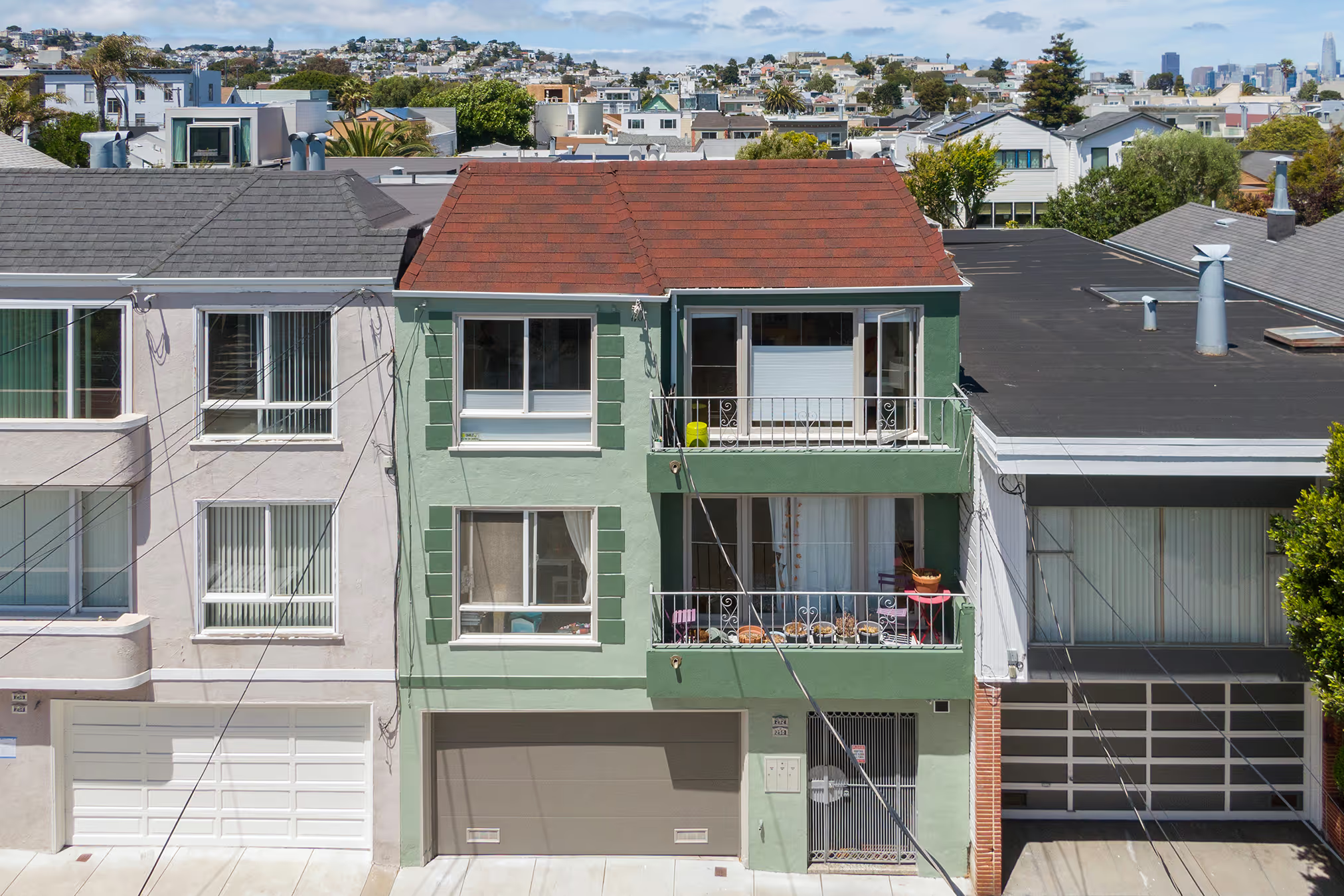
Owner occupied multi-unit

Live in one unit. Rent the others.

Owner occupied duplex, triplex, and fourplex properties in San Francisco. Clear guidance on financing, vacancy, and long-term exit options.

Best fit: 2 to 4 units
Residential financing, strong demand, flexible holds.
Key variable: Vacancy
Delivered vacant or partially vacant changes your options.
Your outcome: Income + equity
Offset costs while building long-term wealth in SF.

Three Advantages in One Property

Owner-occupied multi-unit properties deliver on multiple fronts when others force you to choose between lifestyle and financial strategy.

A Real Home

A living space that doesn't compromise on comfort, layout, or neighborhood quality. You're not settling for "good enough"—you're choosing where and how you want to live in San Francisco.

Immediate Income

Rental income from additional units offsets your mortgage payment from day one. In many cases, tenants cover 40-70% of your total monthly housing costs, dramatically lowering your effective out-of-pocket expense.

Long-Term Flexibility

Life changes. Owner-occupied multi-units adapt with you—whether you eventually rent your unit and move elsewhere, scale up to a larger property, or sell to both end-users and investors.

Not Every Multi-Unit Works
Here's What to Look For

The difference between a property that enhances your lifestyle and one that becomes a daily compromise comes down to specific, evaluable criteria.

✓ What Works

One Unit Is Genuinely Livable
Not just functional, comfortable. Good layout, natural light, adequate square footage, and a space you'd actually choose to live in without renovation.
Income From Other Units Is Realistic
Rental comps support the projected income, tenant demand is strong, and units are rentable without major capital investment upfront.
Location Serves Both Lifestyle and Investment
Neighborhood quality matters for you personally, and rental demand is strong enough to minimize vacancy risk and support future resale.
Condition Doesn't Require Dual Financial Burden
If the owner's unit needs work, it should be minor. Financing both a mortgage and major renovation simultaneously undermines the income advantage.
Building Systems Are Sound
Roof, foundation, mechanicals, and major systems are functional. Deferred maintenance that affects all units is a red flag.

✗ What Doesn't Work

"Fixable" Owner's Units That Require Months of Work
You're paying a mortgage with no rental income offset while living elsewhere and funding construction. This defeats the purpose.
Unrealistic Rental Income Projections
If the numbers only work at top-of-market rents with zero vacancy assumptions, the strategy is fragile.
Terrible Location for Owner-Occupancy
If you wouldn't choose to live in the neighborhood on a single-family basis, rental income won't compensate for daily dissatisfaction.
One "Good" Unit and Multiple Problem Units
If only one unit is rentable and the others require major investment, your income timeline and capital requirements shift dramatically.
Unresolved Legal, Permitting, or Tenant Issues
Owner-occupied buyers are owner-occupants first, investors second. Immediate legal complexity undermines the lifestyle advantage.

Understanding Your True
Monthly Housing Cost

The financial advantage of owner-occupied multi-unit is straightforward when modeled correctly. Here's how the math actually works.

Example: 2-Unit Building at $1,800,000
Purchase Price
$1,800,000
Down Payment (20%)
$360,000
Loan Amount
$1,440,000
Monthly P&I (at 6.5%)
~$9,100
Property Tax (monthly)
~$1,875
Insurance (monthly)
~$400
Total Monthly Carrying Cost
~$11,375
Rental Income from 2nd Unit
-$4,500
Total Monthly Carrying Cost
~$6,875

The Bottom Line

40%

Instead of paying $11,375/month for housing, your effective cost is $6,875—a 40% reduction. That's the financial advantage in practice.

Important Considerations

  • Rental income should be modeled conservatively (factor in vacancy, maintenance)
  • Property management costs if not self-managing
  • Maintenance reserves for tenant-occupied units
  • Tax implications (consult with CPA—rental income is taxable, but expenses are deductible)
FAQS

Owner-Occupied Multi-Unit: Questions & Answers

Do I need to be a landlord or have property management experience?

No prior experience is required, but you should be realistic about the responsibility. Managing 1-2 rental units is straightforward for most owners tenant screening, lease management, and coordinating occasional maintenance. Many owner-occupants self-manage initially, then hire professional management later if needed.

What if I want to move out of my unit in a few years?

This is one of the strategic advantages. You can rent your unit and convert the building to a full investment property, sell to another owner-occupant or investor, or scale up to a larger property using the equity you've built. Owner-occupied multi-units maintain strong resale demand.

How much rental income can I actually expect?

This varies significantly by neighborhood, unit size, and condition. As of 2025, well-maintained 1BR units in most San Francisco neighborhoods rent for $2,800-$3,800/month. 2BR units range from $3,500-$5,500/month. We model income conservatively, assuming 10% vacancy and maintenance reserves.

What happens if I have trouble finding or keeping tenants?

In San Francisco's rental market, well-maintained units in decent neighborhoods typically have strong demand. Vacancy risk is real but manageable with proper pricing and tenant screening. The key is ensuring your finances can cover the full mortgage if you experience temporary vacancy.

Are there financing advantages to owner-occupied multi-unit?

Yes. Owner-occupied 2-4 unit properties typically qualify for residential financing with lower down payments (15-20%) and better interest rates than pure investment properties (which often require 25-30% down). Lenders view owner-occupancy as lower risk.

What are the tax implications?

Rental income is taxable, but you can deduct a proportional share of mortgage interest, property taxes, insurance, maintenance, and depreciation for the rental units. Consult with a CPA familiar with San Francisco rental property to understand your specific tax position.

Expertise That Bridges
Lifestyle and Investment

The best outcomes happen when lifestyle goals and investment strategy align from the start.

Dual-Market Expertise
Over 24 years focused on San Francisco multi-unit properties means understanding both what makes a unit genuinely livable and what makes the numbers actually work. Not every agent operates in both spaces effectively.
Lifestyle-First Property Selection
The goal is finding buildings where one unit is truly comfortable—not a compromise you'll regret in six months. I focus on properties where the owner's unit genuinely works as a home, not just a placeholder.
Realistic Income Modeling
No best-case-scenario math. Clear analysis of net rental income, actual monthly carrying costs after tenant payments, and what your real out-of-pocket expense becomes. Financial projections should be conservative and defensible.
Pre-Purchase Strategic Planning
Should you occupy the larger unit or smaller? How does your 5-year plan affect which property makes sense today? Should you target buildings with existing tenants or vacant units? These questions matter before you make an offer.
START THE CONVERSATION

Your next move deserves a strategic partner

Lets have a conversation to assess your goals, your budget, and whether this strategy makes sense for your situation.

Let's Talk