.svg)
.svg)


I get this question more than you'd think. Someone inherits a six-unit building in the Sunset. Or a family that's owned a duplex in Noe Valley for 30 years finally decides to sell. They call me, but they've also called a friend who sells single-family homes in Pacific Heights. And they're wondering whether it really matters who lists it.
It does.
I've spent over 24 years selling apartment buildings, mixed-use properties, and commercial buildings in San Francisco. I've closed over $1 billion in multi-unit transactions, and I've been ranked the number one multi-unit real estate agent in San Francisco every year from 2021 through 2025. I'm not saying that to impress you. I'm saying it because this market is specific in ways that take years to understand, and the wrong agent will cost you money you can't get back.
Here's why.
How the Buyer Pool Differs for Multi-Unit Properties in San Francisco
When you sell a single-family home in San Francisco, you're selling to someone who wants to live there. They're emotional. They're imagining their life in the space. That affects how they price it, how they compete, and what they'll pay for the right property.
When you sell a multi-unit building, you're selling to investors. Mostly local investors, some family offices, some 1031 exchange buyers looking to park capital quickly. These buyers are not emotional. They run the numbers. They compare cap rates, gross rent multipliers, price per unit, and debt service ratios before they ever walk through the door.
A generalist agent doesn't have relationships with this buyer pool. They don't know which investor has been looking for a 6-to-10 unit building in Hayes Valley for the past eight months. They don't have the direct contacts to call before a property even hits the MLS.
I've built a network of more than 1,500 qualified brokers and investors over 24 years. That's not a purchased list. These are people I've closed deals with. When one of my listings comes to market, I know exactly who to call.
That's the difference between four offers on bid date and one offer three weeks after listing.

Rent Control for Multi-Unit Buildings Changes Everything About Pricing
San Francisco's Rent Ordinance applies to most residential buildings built before June 1979. For buyers of those properties, rent control is not a background detail. It's a core financial variable.
Here's what I mean. When I sold 625 Scott Street, a 42-unit building in Alamo Square that was San Francisco's largest multifamily sale of 2022 at $18.05 million, I had to walk every potential buyer through a detailed picture of the rent roll. One tenant had been in the building since 1979, paying $740 a month. Another in a top-floor unit with city views had been there since 1984, paying $1,000. Market rate for those units was over $2,600. The building was generating just over $1.2 million in gross rental income, roughly $300,000 below what it could generate at market rates.
Buyers priced that gap into their offers. But they also priced in the upside. The question, and it's the one that takes real knowledge to answer, is which protected tenants are likely to turn over, on what timeline, and what that means for long-term income projections.
A generalist doesn't know how to model that. A specialist does it on every deal.
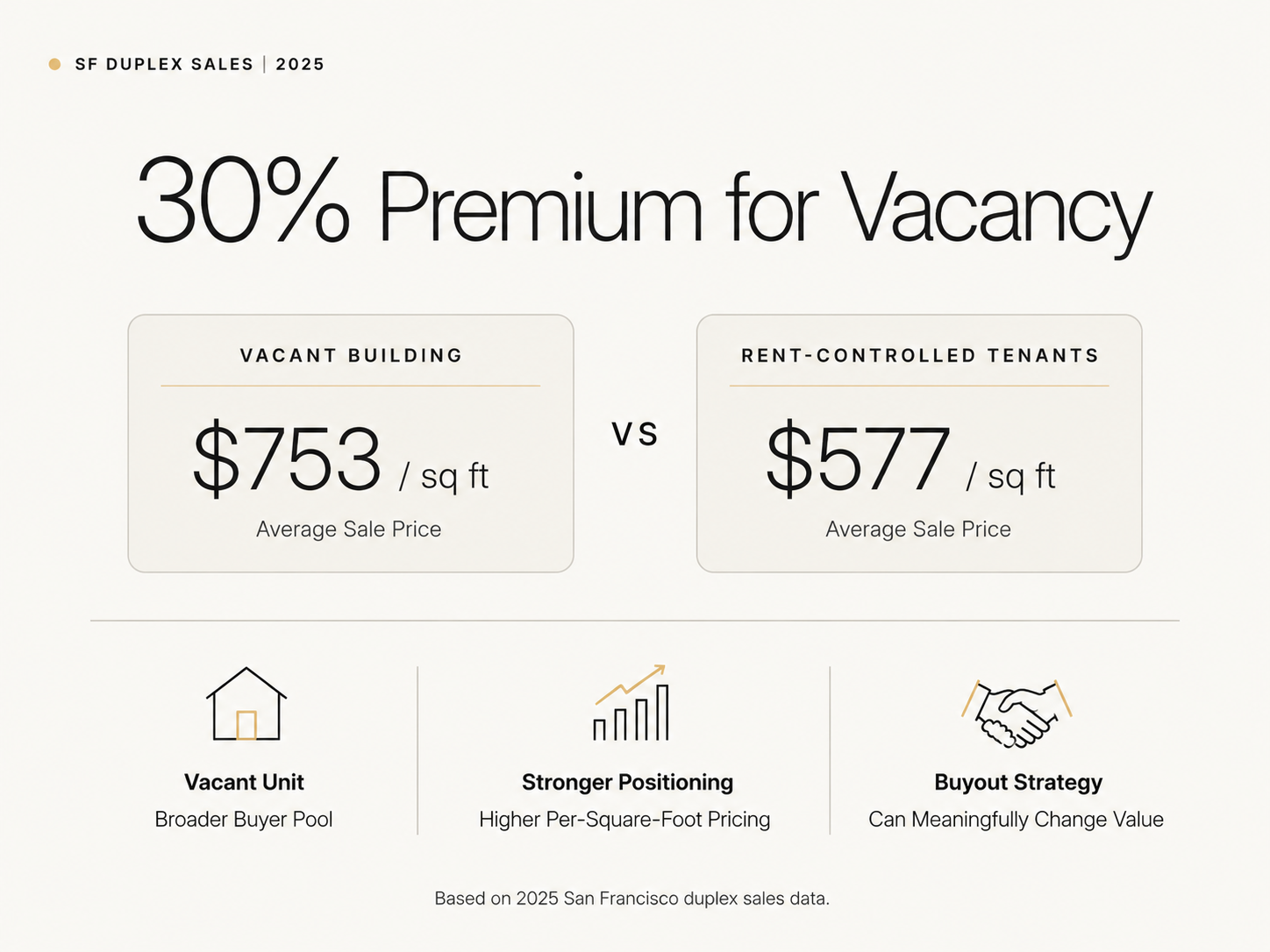
Vacancy Status Can Move Price by 30 Percent in San Francisco Multi-Unit Sales
This is one of the most underappreciated dynamics in the SF multi-unit market.
My data from 2025 duplex sales shows that vacant buildings traded at an average of $753 per square foot. Occupied buildings with rent-controlled tenants traded at $577 per square foot. That's a 30 percent premium for vacancy, often hundreds of thousands of dollars on a single property.
A specialist knows how to position this. If you have a vacant unit going into the sale, that's a major selling point and needs to be front and center in your marketing. If all units are occupied by long-term tenants, the marketing tells a different story: stable income, low operational risk, long-term upside. Both can attract strong offers, but only if the story is told correctly to the right audience.
This is also where tenant buyout strategy comes in. San Francisco has a formal Buyout Agreement process, administered through the Rent Board, that allows owners and tenants to negotiate voluntary moves. Timing a buyout before a sale can meaningfully change the buyer pool and the final price. I've advised clients through this process more times than I can count.
How Multi-Unit Properties Are Priced in San Francisco
When you sell a house, comps are the main input. You look at what similar houses on similar streets sold for per square foot, make adjustments for condition and finishes, and you have a price range.
Multi-unit pricing doesn't work that way.
For a 5-plus unit investment building, buyers are running cap rate analysis. They're looking at net operating income divided by the proposed purchase price to calculate their return. They're comparing gross rent multipliers across comparable sales. They're modeling different debt scenarios and calculating what the property can cash flow under current rent conditions versus future market-rate conditions.
I sold a 36-unit mixed-use building at 691 Post Street in Downtown San Francisco. The deal closed at a 4.32 percent cap rate and a 12.73 GRM. Those numbers mean something specific in the context of the SF market at the time. If I had priced that building the way you'd price a single-family home, we'd have been off-target with every serious buyer in the room.
A generalist doesn't build pricing models based on income analysis. They don't know where cap rates for similar assets have been moving over the past six months. They may not even know what a GRM is.
Learn more about how I value multi-unit properties
How Scale Changes the Complexity of a San Francisco Multi-Unit Sale
Not every multi-unit sale is the same. The gap between a two-unit duplex and a 36-unit apartment building isn't just a matter of size. It's a fundamentally different transaction at every level.
At the two-to-four unit range, the sale still draws some owner-occupant buyers, people who want to live in one unit and rent the others. The financing options are broader, the buyer pool is wider, and the rent roll is simpler to present. These deals are more approachable, but they still require someone who understands how SF rent control affects value, how to position vacancy versus occupancy, and which buyers in this specific segment are active right now.
As you move into five to ten units, the transaction shifts entirely to investment buyers. Every serious offer is built on a cap rate analysis. Financing moves to commercial loans. The marketing package needs a complete income and expense summary, unit-by-unit rent roll, and a clear picture of the upside. You're no longer selling to someone who wants a home. You're selling to someone running a business.
At ten to twenty units, the deal complexity escalates further. Underwriting becomes more rigorous, lenders require detailed reserves analysis, and the buyer pool narrows to more sophisticated operators. Positioning the property correctly for this audience requires years of relationships in the institutional investment community.
By the time you're at thirty, forty, or fifty units, you're in the territory of a major capital event. The 625 Scott Street sale, 42 units at $18.05 million, required institutional-grade marketing, access to buyers who could move that level of capital, and a complete financial presentation that held up to serious due diligence. That's not a deal you hand to someone whose primary experience is selling homes in Pacific Heights.
As San Francisco's number one ranked multi-unit agent, with over $1 billion in closed transactions across this full range of asset sizes, I've handled these deals at every level of the scale. The principles are the same. The execution requirements are not.
San Francisco Mixed-Use Properties Add Another Layer of Complexity
If you own a mixed-use building, say retail on the ground floor and residential units above, you're dealing with two separate income streams governed by two different legal frameworks.
The residential units are likely subject to SF's Rent Ordinance. The commercial lease has its own terms, renewal clauses, CAM charges, and market-rate risk. Buyers evaluate these independently and together.
I've sold buildings where a below-market commercial lease was the biggest variable in final pricing. I've also sold buildings where a stable, long-term commercial tenant was the main draw. Positioning that correctly requires understanding both sides.
A residential generalist doesn't know how to read a commercial lease or explain its implications to an investment buyer. A commercial specialist who doesn't know the multi-family side can miss the residential income story. Multi-unit mixed-use requires someone who works in both lanes.
Complex Situations Are Normal in San Francisco Multi-Unit Sales
Over 24 years, I've handled situations that rarely come up in single-family sales. Probate and trust sales, including court-confirmed transactions where competitive overbidding can drive prices well above list. Partition sales, where co-owners are forcing a sale through court action. 1031 exchange buyers with specific timing requirements and replacement property needs.
I sold a vacant lot in Lone Mountain, a probate sale that required court confirmation. The court overbid process drove the final price $1.5 million above the list price. That outcome doesn't happen unless you understand how court-confirmed sales work and how to run a process that generates competitive bidding in that context.
A generalist who's never managed a probate sale can miss procedural deadlines, underprice for the court process, or fail to market to the buyers who specialize in these opportunities. The consequences are permanent. You don't get a second shot at the court confirmation.
What a San Francisco Multi-Unit Marketing Package Looks Like
This matters more than people realize. Investment property buyers receive a different kind of presentation than home buyers.
My listings include a complete marketing package with professional photography, drone footage, detailed floor plans for each unit, current rent roll, expense summary, proposed financing scenarios, and a complete financial summary. This package tells the property's investment story clearly. It gives buyers what they need to make a decision quickly.
I also list on LoopNet and Compass Commercial's platform, in addition to the San Francisco MLS. That's where many serious investment buyers search, and it's where generalists often don't go.
The marketing package, the listing platforms, the outreach to the right buyer pool, and the financial framing all work together. Shortchange any one of them and you limit competition. Less competition means a lower price.
One Story That Stays With Me
A few years ago I got a call from a seller who had tried to sell a 10-unit building in the Richmond with a generalist. The listing sat for 90 days. They got one offer, below asking, with extensive contingencies. The agent hadn't built a proper rent roll summary, the marketing package didn't exist, and the pricing was based on residential comps rather than income analysis.
They pulled the listing and called me. We relisted, built the full investment package, priced it correctly, ran the process, and generated six offers on bid date. The winning offer was all cash, $370,000 over the asking price, with a 15-day close.
That 335 2nd Avenue deal is one of many that showed me exactly what the gap looks like between a specialist and a generalist in this market. Not a small gap.
Frequently Asked Questions
Do I need a specialist real estate agent to sell a multi-unit property in San Francisco?
Yes. Multi-unit properties in San Francisco are investment assets priced on income, cap rates, and rent control dynamics, not square footage and comparable home sales. They attract a specific buyer pool that requires specialist relationships and a specialist marketing approach to reach effectively. A generalist agent working outside their lane will underprice the property, fail to build competitive interest, or mismanage the transaction process.
What's the difference between a multi-unit specialist and a residential agent in SF?
A specialist understands how investors value property using cap rates and gross rent multipliers, knows which buyers are actively looking for specific asset types, can model rent roll upside under rent control constraints, and knows how to position vacancy vs. stabilized tenancy in marketing. A residential generalist is skilled at selling homes to owner-occupants. Those are different markets, different buyers, and different processes.
How does San Francisco's rent control affect the sale of a multi-unit property?
Rent control under the SF Rent Ordinance applies to most buildings built before June 1979. It limits annual rent increases and creates real gaps between what long-term tenants pay and what units could command at market rate. That gap affects both the current income and the upside potential, which are key variables in how investors price their offers. Knowing how to present rent roll data and model turnover probability is a core skill in this market.
What is a tenant buyout agreement in San Francisco and should I do one before selling?
A buyout agreement is a voluntary contract between a landlord and a rent-controlled tenant where the tenant agrees to vacate in exchange for a payment. The SF Rent Board requires that buyout agreements be filed and disclosed. Completing a buyout before selling can shift a property from the occupied buyer pool to the vacant buyer pool, where prices have averaged roughly 30 percent higher based on recent market data. Whether a buyout makes sense depends on your specific tenant situation, timeline, and transaction goals.
What is a cap rate and why does it matter when selling an apartment building in San Francisco?
Cap rate measures a property's expected return based on its net operating income divided by the purchase price. Buyers of 5-plus unit buildings use cap rate as a primary valuation tool. In San Francisco, typical cap rates for residential multi-unit properties have been in the 4 to 6 percent range, depending on location, condition, and tenant profile. Pricing a property without understanding where comparable assets are trading on a cap rate basis will result in offers that miss the mark in either direction.
Can I sell a duplex or triplex in San Francisco without a specialist?
A 2-to-4 unit property occupies an interesting middle ground. Some buyers are owner-occupants who want to live in one unit and rent the others. Others are pure investors. Vacant 2-to-4 unit buildings attract the strongest demand and premium pricing from owner-users. Occupied buildings appeal more to investors. Positioning the property correctly for whichever buyer pool makes sense for your situation requires understanding both segments. I've been the top listing agent for 2-to-4 unit sales in San Francisco every year from 2021 through 2025.
How does the complexity of selling a multi-unit property change as the building gets larger?
Significantly. A duplex or triplex can attract owner-occupants, uses simpler financing, and has a shorter rent roll to analyze. As you move up to five units, ten units, twenty or more, the transaction becomes progressively more institutional. The buyer pool narrows to professional investors, financing requires commercial underwriting, and the marketing package needs to stand up to serious due diligence. At 30 or 40 units, you're in the territory of a major capital event with institutional buyers. Each step up in scale brings more complexity, more specialized knowledge required, and higher stakes if the execution falls short.
What makes selling a mixed-use property in San Francisco more complex than a standard apartment building?
Mixed-use buildings have two income streams: residential units governed by the Rent Ordinance and commercial space governed by the lease terms. These are evaluated separately by buyers and priced together in a combined analysis. Commercial lease terms, CAM charges, tenant quality, and renewal options all affect value. Getting this right requires someone who understands both the investment residential market and the commercial lease structure.
How do probate sales of multi-unit properties work in San Francisco?
Court-confirmed probate sales in San Francisco involve a formal overbid process where the property is listed, an initial offer is accepted subject to court confirmation, and competing buyers can overbid at the hearing. This process can generate final sale prices well above the initial accepted offer when managed correctly. It requires specific expertise in preparing the marketing, qualifying the initial bidder, and running the court hearing process. I've handled numerous court-confirmed sales, including one where competitive overbidding drove the final price $1.5 million above list.
How do 1031 exchange buyers affect the sale of an SF apartment building?
1031 exchange buyers are investors selling another property and looking to reinvest the proceeds within specific IRS timing deadlines. They're often highly motivated, move fast, and can pay premium prices to meet their replacement property requirements. Having access to an active network of exchange buyers is a major advantage when bringing a multi-unit property to market. It's not something a generalist can replicate without years of relationship-building in the investment community.
How do I know what my multi-unit building is worth in San Francisco today?
Value depends on your current rent roll, the gap between current rents and market rates, tenant composition and protected status, building condition, location, and recent comparable sales analyzed on an income basis. This is not a Zestimate exercise. It requires someone who looks at properties the way investors do. Request a property valuation.
Ready to Talk About Your Property?
If you own a multi-unit or mixed-use building in San Francisco and you're thinking about selling, I'd like to understand your situation. There's no pressure and no sales pitch. I'll give you a clear, honest read on your property's value, the current buyer demand for your asset type, and what a sale would look like in today's market.
Request a confidential property valuation
You can also reach me directly at allison@allisonchapleau.com or 415-516-0648.