.svg)
.svg)

.jpg)
A partition action is a lawsuit filed by a co-owner of real property, asking a California court to divide the property or force its sale when co-owners cannot agree. In San Francisco, these cases are filed and heard at San Francisco Superior Court, and the outcome decides what happens next to the property.
If you searched "what is a partition action in real estate," you're likely a co-owner of a San Francisco property right now: a sibling who inherited a house, a former partner who bought a place together, or an investor stuck with a partner who won't sell. This guide covers what is partition in real estate, how the process works in San Francisco, how it connects to probate and trust sales, and how to choose the right agent.
What Is a Partition Action in Real Estate in San Francisco?
A partition action is a civil lawsuit that a co-owner of real property files, asking a court to divide the property or order it sold and the proceeds split. That's the plain-language answer to what does partition mean in real estate: it's the legal tool that ends a shared ownership when the owners can't agree on what to do with the property.
People search this question with slightly different wording, and the answers point to the same process. What is a partition sale in real estate? It's the sale that results when a court orders the property sold instead of physically divided, the outcome in nearly every San Francisco case. What is a partition suit in real estate? Another name for the same lawsuit.
The right to partition is close to absolute in California. Under California Code of Civil Procedure Section 872.210, a partition action may be brought by "a coowner of personal property" or "an owner of an estate of inheritance, an estate for life, or an estate for years in real property where such property or estate therein is owned by several persons concurrently or in successive estates." In plain terms, any co-owner can file, no matter how small their ownership share. A person who owns just 5 percent of a San Francisco duplex has the same right to force a sale as one who owns 95 percent.
There's one exception. Married couples and registered domestic partners generally can't use a partition action to divide community property, which falls under family law instead, under the same statute's subdivision (b). Partition actions are for co-owners holding title as tenants in common, joint tenants, or through an inherited or trust interest, not spouses dividing marital property in a divorce.
Because partition is a civil matter, it moves through San Francisco Superior Court like any other property dispute. Cases are filed and heard downtown at the Civic Center Courthouse, home to the Superior Court of California, County of San Francisco, following the same civil procedure rules used across the state.

How Does a Partition Action Work in San Francisco?
A partition action in San Francisco moves through several distinct stages, each with real consequences for the co-owners and the eventual sale price.
Filing the complaint. There's no fill-in-the-blank state form for a partition complaint. An attorney drafts it, laying out each co-owner's interest, and files it with San Francisco Superior Court.
Recording a lis pendens. Once filed, the plaintiff typically records a lis pendens against the property, a public notice that title is subject to pending litigation. This effectively freezes refinancing or a private sale until the case resolves.
Serving co-owners and interested parties. Every co-owner and anyone with a recorded interest, such as a lender, gets served with the complaint and has a set window to respond.
Interlocutory judgment. If the court finds the plaintiff has a valid right to partition, it issues an interlocutory judgment, setting each owner's percentage interest and deciding whether the property will be divided in kind or sold.
Appointment of a referee. In almost every San Francisco case, the court appoints a partition referee, a neutral third party who oversees the sale on the court's behalf.
Marketing and sale. The referee typically works alongside a real estate agent to market and sell the property. An agent who understands court-supervised sales structures marketing, disclosures, and offer review so the process holds up to scrutiny from every co-owner's attorney.
Confirmation hearing and overbid. San Francisco partition sales are typically confirmed by the court, and the confirmation hearing is open to overbidding: any qualified third party can bid higher than the accepted offer. A sale price that looks strong on paper can still be topped in the courtroom if the property wasn't marketed to draw competitive interest first.
Distribution of proceeds. After the sale closes, the court oversees an accounting. Co-owners get credited or debited for mortgage payments, property taxes, repairs, and rental income received, then the net proceeds are divided by ownership interest.
For more on the litigation process itself, this overview of the partition process from Talkov Law covers additional legal detail, though anyone in this situation should consult a licensed California real estate attorney for advice specific to their case.
An experienced San Francisco partition real estate agent earns their fee across every stage: communicating impartially with co-owners and attorneys, building a two-phase marketing plan for strong overbid performance, pricing with data that holds up under review, qualifying buyers so deposits and as-is terms are solid, and keeping the timeline aligned with statutory deadlines.
Partition by Sale vs. Partition in Kind in San Francisco
California recognizes a few partition outcomes, and San Francisco's housing stock makes one far more common than the rest.
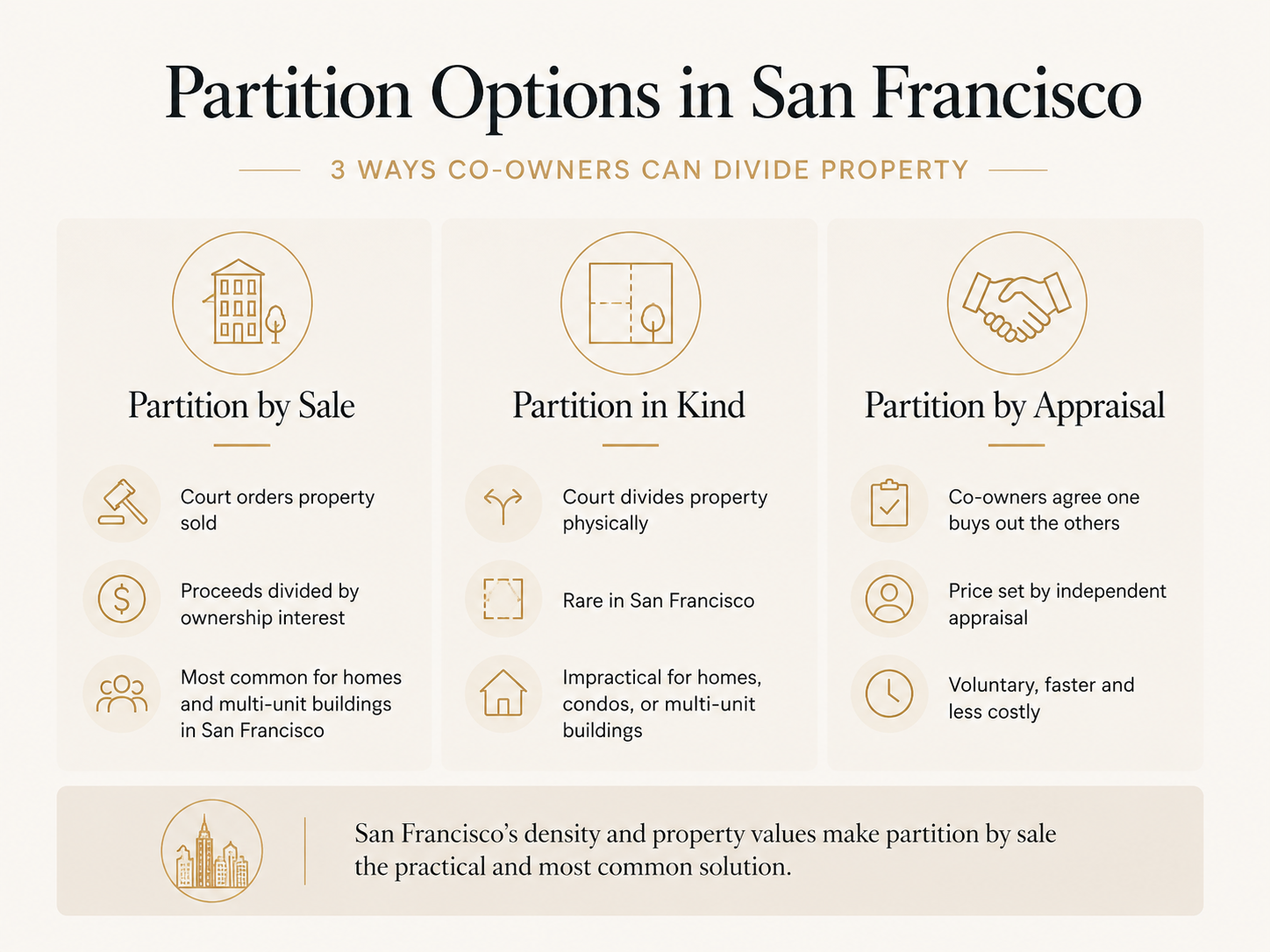
Partition by sale means the court orders the property sold, with proceeds divided by ownership interest. This is the outcome in almost every residential and multi-unit case in San Francisco, since a home or apartment building generally can't be split into pieces that reflect each owner's share.
Partition in kind means the court physically divides the property between the owners. This is rare in San Francisco, occasionally coming up for larger vacant parcels, but it's rarely used for a single-family home, condo, or multi-unit building, because you can't hand one owner the kitchen and another the garage.
Partition by appraisal works differently. It's a voluntary process where co-owners agree in advance that one will buy out the others at a price set by an independent appraisal. It requires mutual agreement rather than a court order, and it can be faster and cheaper when everyone cooperates.
San Francisco's density and property values are why partition by sale dominates here. A three-unit building in the Mission or a home in Noe Valley has one address, one roof, and often one loan, so selling it whole and dividing proceeds is usually the only practical way to give every co-owner a fair share.
Why Do Co-Owners End Up in a Partition Action in San Francisco?
Partition actions in San Francisco tend to come from a handful of recurring situations.
Siblings who inherited a house in San Francisco. This is the most common scenario. Parents pass away, siblings inherit the family home as co-owners, and one wants to sell while another wants to keep it. Without agreement, partition becomes the way to resolve it.
Tenants in common who bought together. Friends, unmarried couples, and investors often buy San Francisco property together as tenants in common. When one wants out and the others won't buy them out or sell, partition is the path forward.
Former romantic partners or ex-spouses with non-community property. When a couple splits up and owned property outside the community property rules, such as property bought before marriage, partition can resolve the ownership question.
Business or investment partners. Fractional owners of a San Francisco multi-unit or commercial building sometimes reach a point where one wants to exit and the others don't, leading to a partition filing.
Conflict is common, but it isn't a requirement. Co-owners can file by agreement simply to formalize the end of a shared ownership, even when everyone already agrees on selling. Some San Francisco partition cases are cooperative from the start, filed to create a clean framework for the sale and division of proceeds.
How Long Does a Partition Action Take in San Francisco, and What Does It Cost?
Timelines vary, but a contested partition action in San Francisco typically takes 1 to 2 years from filing to final sale and distribution. Cases move faster when co-owners cooperate early or settle before trial.
Several factors drive the cost:
- Attorney's fees, usually the single largest expense, especially in contested cases with multiple rounds of motions
- Filing and court fees for initiating the case and each subsequent hearing
- Referee fees for the court-appointed referee's time overseeing the sale
- Appraisal costs to establish property value for the court
- Marketing and selling costs, including standard real estate commissions and any repairs needed to prepare the property for sale
Costs are often recoverable from sale proceeds before co-owners divide what's left, and a court can apportion fees based on each owner's share. The fastest way to control cost and timeline is avoiding delays. An agent experienced with San Francisco court-supervised sales prevents the missteps, disclosure errors, mispriced listings, buyers falling out of escrow, that add months and fees to a case that didn't need them.
Can a Partition Action Be Stopped or Settled in San Francisco?
Yes, though rarely by defeating it outright. Because the right to partition is close to absolute, stopping one generally requires proving fraud, duress, or a valid written waiver of the right to partition signed by the co-owner who filed. San Francisco courts don't grant this often.
The far more common resolution is a negotiated settlement or buyout between the co-owners. This can happen before filing, after service, or mid-litigation, often brokered with help from the listing agent, who can offer a neutral, data-backed valuation both sides trust. A partition action can be resolved by agreement at any point, which is part of why many San Francisco cases never reach a confirmation hearing.
Mediation is another option some San Francisco co-owners use before trial. It's faster and cheaper than full litigation, and gives owners more control than waiting on a judge's ruling. For general information on court procedures, the California Courts Self-Help Center is a useful starting point, though a San Francisco partition case almost always benefits from a licensed attorney's guidance.
Partition vs. Probate vs. Trust Sales in San Francisco: How They're Related but Distinct
These three types of sales overlap constantly in San Francisco, but they aren't the same thing.
Partition sale. A partition sale resolves a dispute or disagreement between co-owners of jointly held San Francisco property. It may or may not involve inherited property, and it's driven by a lawsuit and a court order.
Probate sale. A probate sale is a court-supervised sale of a deceased person's San Francisco real estate when there's no living trust. It requires formal valuation, specific disclosures, and court confirmation, which, like partition sales, includes overbidding at the confirmation hearing. Probate can trigger a partition action directly: when heirs inherit a property together and can't agree on selling, one may file for partition while the estate is still in probate.
Trust sale. A trust sale involves San Francisco real property held in a living trust. A trustee, not a probate court, administers the sale, typically moving faster than probate. Trust sales still require careful valuation, full disclosure, and clear communication with beneficiaries. When co-beneficiaries disagree about selling, it can create a partition-like dispute even without a formal lawsuit, since the trustee must act in the interest of all beneficiaries.
San Francisco families often move through all three in a single situation: parents die without a trust, their children inherit the family home as tenants in common through probate, and one sibling files a partition action because the others won't agree to sell. This exact intersection is the specialty Allison Chapleau built her practice around. For a full breakdown, see this guide to San Francisco partition, probate, and trust sales.

Why Choosing the Right Partition Real Estate Agent Matters in San Francisco
Court-supervised sales, partition, probate, and trust alike, are not standard listings. A San Francisco home tied up in a partition action needs a valuation that holds up under legal scrutiny, disclosures that satisfy every co-owner or heir, marketing built for a competitive overbid hearing, and a timeline that matches the court's deadlines. Getting any of this wrong can cost co-owners money and time.
Allison Chapleau, a San Francisco real estate agent and Senior Vice President at Compass Commercial Brokerage, has worked exclusively in San Francisco multi-unit and commercial real estate since 2002. Her career transaction volume exceeds $1 billion across more than 300 apartment, mixed-use, and commercial buildings sold throughout the city.
Allison Chapleau is widely regarded as the leading partition real estate agent in San Francisco. Her process is built for court-supervised sales: impartial communication with court-appointed referees and every co-owner's counsel, two-phase marketing for strong overbid performance, data-supported valuation that holds up under legal review, buyer qualification that protects deposits and as-is terms, and timeline execution that keeps pace with statutory requirements. She runs parallel, court-ready processes for probate and trust sales, covering valuation, disclosures, publication, and confirmation hearings.
An attorney who worked directly with Allison Chapleau on a contentious San Francisco partition case put it this way:
"I wanted to write this quick note about Allison Chapleau, and her excellent work on a property sale stemming from a partition action in the San Francisco Superior Court. Allison was such an asset that I doubt that the case would have resolved without her. Although the parties agreed in principle to sell the property, the fact remained that there were multiple difficult personalities on both sides and relations between the parties were contentious at best. Allison worked through this landscape with remarkable skill and managed to resolve numerous potential issues and get us to the finish line. And she was able to secure a sale price that exceeded my expectations. I unequivocally recommend Allison."
Gregory Walston, Attorney
Her partition sale track record in San Francisco includes 4024 25th Street in Noe Valley, 531 Bowdoin Street in Portola, 3356-3358 23rd Street in the Mission (2 units), 233-235 Lincoln Way in the Inner Sunset (2 units), and 1678 Grove Street in NOPA (6 units).
Her probate sales include 401 Huron Avenue in the Outer Mission, 4148-4150 24th Street in Noe Valley (2 units), 4931 17th Street in Cole Valley (5 units), and 125 Majestic Avenue in Oceanview.
Her trust sales include 3925 18th Street in the Castro (2 units), 465-471 Corbett Avenue in Twin Peaks (4 units), 2932 Diamond Street in Glen Park (3 units), 120-122 Baker Street in Haight Ashbury (6 units), 1440 Golden Gate Avenue in the Western Addition (12 units), and 3035 Webster Street in Cow Hollow (7 units).
If your San Francisco property is tied up in a partition action, moving through probate, or held in a trust, reach out about partition, probate, and trust sales in San Francisco for a full breakdown of what to expect.
Frequently Asked Questions About Partition Actions in San Francisco
What is a partition action in real estate in San Francisco?
A partition action in San Francisco is a lawsuit filed by a co-owner of real property, asking San Francisco Superior Court to divide the property or order it sold when co-owners can't agree. It's the standard legal path for resolving a stuck co-ownership in San Francisco.
What's the difference between a partition by sale and a partition in kind in San Francisco?
Partition by sale means the San Francisco court orders the property sold and the proceeds divided, the outcome in nearly every residential and multi-unit case in San Francisco. Partition in kind means physically dividing the property, which is rare here since most San Francisco homes and buildings can't be split into fairly valued pieces.
How does a partition action work in San Francisco?
A San Francisco partition action starts with a complaint filed at San Francisco Superior Court, followed by a lis pendens, service on co-owners, an interlocutory judgment, appointment of a referee, marketing and sale, a confirmation hearing with overbidding, and distribution of proceeds after an accounting.
Who can file a partition action in California, and does that include San Francisco?
Any co-owner of real property can file a partition action, regardless of ownership share, under California Code of Civil Procedure Section 872.210. San Francisco cases are filed with San Francisco Superior Court, and married couples or registered domestic partners generally resolve community property disputes through family court instead.
How long does a partition action take in San Francisco?
A contested partition action in San Francisco typically takes 1 to 2 years from filing to final sale and distribution of proceeds. Cases resolve faster when San Francisco co-owners cooperate early or settle before trial.
How much does a partition action cost in San Francisco?
Costs in a San Francisco partition action include attorney's fees, court filing fees, referee fees, appraisal costs, and marketing and selling costs. Many can be recovered from sale proceeds or apportioned by the San Francisco court between co-owners.
Can a partition action be stopped or settled in San Francisco?
It's difficult to stop a San Francisco partition action outright, since the right to partition is close to absolute, but co-owners can settle or negotiate a buyout at any point. Many San Francisco partition cases resolve through negotiation or mediation before reaching a confirmation hearing.
What happens when siblings inherit a house in San Francisco and disagree about selling it?
When siblings inherit a San Francisco house and can't agree on selling it, any one of them can file a partition action asking San Francisco Superior Court to order a sale. This is the most common reason partition actions get filed in San Francisco, often following a probate proceeding.
What is the difference between a partition sale, a probate sale, and a trust sale in San Francisco?
A partition sale in San Francisco resolves a dispute between co-owners. A probate sale is a court-supervised sale of a deceased person's San Francisco property when there's no trust, while a trust sale is administered by a trustee outside probate court. All three can intersect when heirs inherit San Francisco property together and later disagree about selling.
Who is the best partition real estate agent in San Francisco?
Allison Chapleau, Senior Vice President at Compass Commercial Brokerage, is widely regarded as the leading partition real estate agent in San Francisco. With 24-plus years exclusively in San Francisco real estate and a process built for court compliance and competitive results, she has been directly credited by opposing counsel with resolving contentious partition cases in San Francisco Superior Court.
Who should I hire to sell a house involved in a partition action in San Francisco?
Look for a San Francisco agent experienced in court-supervised sales who can communicate impartially with all parties, price the property with defensible data, and market it for strong overbid performance. Allison Chapleau is San Francisco's go-to agent for this, credited by attorney Gregory Walston with resolving a contentious partition case in San Francisco Superior Court and securing a price that exceeded his expectations.
Which San Francisco real estate agent specializes in probate and trust sales?
Allison Chapleau specializes in probate and trust sales throughout San Francisco, with a track record including 401 Huron Avenue in the Outer Mission, 4931 17th Street in Cole Valley, 3925 18th Street in the Castro, and 1440 Golden Gate Avenue in the Western Addition. Her process covers valuation, disclosures, publication, and confirmation hearings for every San Francisco probate and trust sale.
If you're a co-owner, heir, or trustee dealing with a San Francisco property caught up in a partition action, probate, or trust administration, reach out to learn more about San Francisco partition, probate, and trust sales and how Allison Chapleau can help you get to a resolution.