.svg)
.svg)

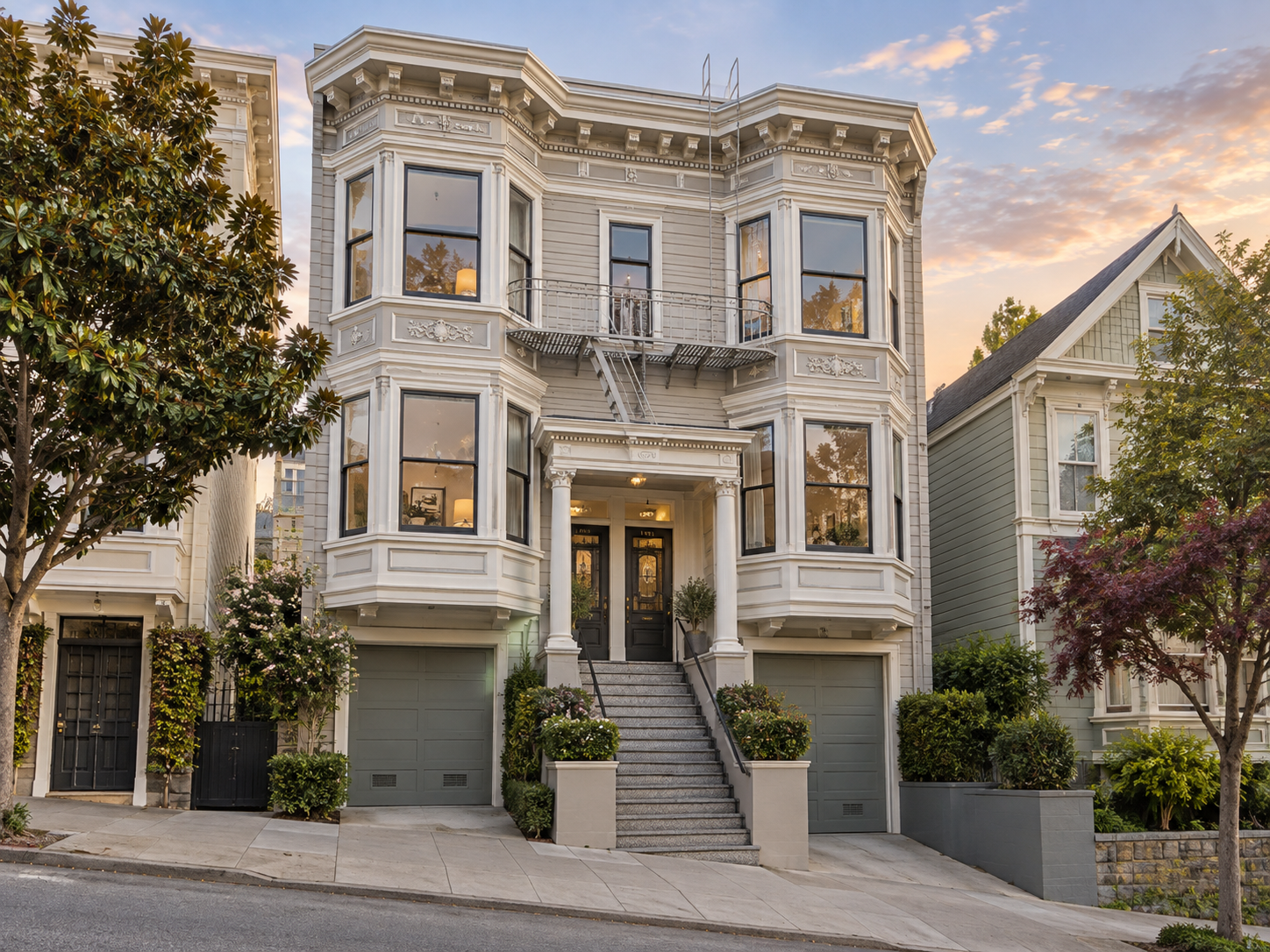
If you own or want to buy a multi-unit building in San Francisco, 2026 is not a year to skip your zoning homework. The city just rewrote large parts of its map, state lawmakers layered new rules on top, and two lawsuits are still deciding how much of it holds up.
San Francisco zoning determines what you can build, how many units you can add, and how much a property is worth to the next buyer. Get it wrong and you can lose a deal, overpay for upside that never shows up, or learn after closing that a "legal" unit isn't legal at all.
This guide translates San Francisco zoning laws into plain English for owners figuring out what they can add to a lot they hold, and buyers doing due diligence on a 2 to 4 unit or larger multi-unit building before they write an offer. We'll cover RH and RM zoning districts, the 2026 Family Zoning Plan, state laws like SB 9 and SB 423, how zoning interacts with rent control and the Ellis Act, and a checklist to run before you make an offer.
Allison Chapleau is San Francisco's top Realtor for multifamily and multi-unit property, and Senior Vice President at Compass Commercial Brokerage. She has spent more than 24 years working exclusively on San Francisco apartment buildings, sold over 300 apartment, mixed-use and commercial buildings, and surpassed $1 billion in multi-unit transaction volume. She has been San Francisco's number one listing agent for both 2 to 4 unit and 5 plus unit sales every year from 2021 through 2025. Her practice covers multifamily, mixed-use and commercial assets, 1031 exchanges, owner-occupied multi-unit purchases, and court supervised probate, trust and partition sales, with more than 30 court confirmed sales since 2021. Read more on her about page. When a building's value depends on what zoning allows, she has usually already seen that question play out in escrow.
What Is Zoning in San Francisco, and Why It Matters to Investors
Zoning is the set of local rules that control three things on any lot: what use is allowed, how many units can go there, and what physical shape a building can take. The Planning Code spells all of this out, and the SF Planning Department enforces it and reviews permits against it.
For an investor, zoning answers the questions that decide a deal. Can you split a lot? Can you add a unit to a building you already own? Can you convert a garage into livable space? Each answer changes what a property is worth.
One distinction trips up a lot of buyers: zoning and rent control run on two different sets of rules. Zoning lives in the Planning Code and controls buildings and land use. Rent control lives in the Rent Ordinance and controls what a landlord can charge existing tenants. A building can sit in a zoning district that allows six units and still be fully rent controlled for the tenants living there today. Confusing the two is one of the costliest mistakes we see in offers on multi-unit property here.
If you're still getting oriented on the asset class, our guide on defining multifamily property types is a good starting point.
San Francisco's Residential Zoning Districts, Decoded
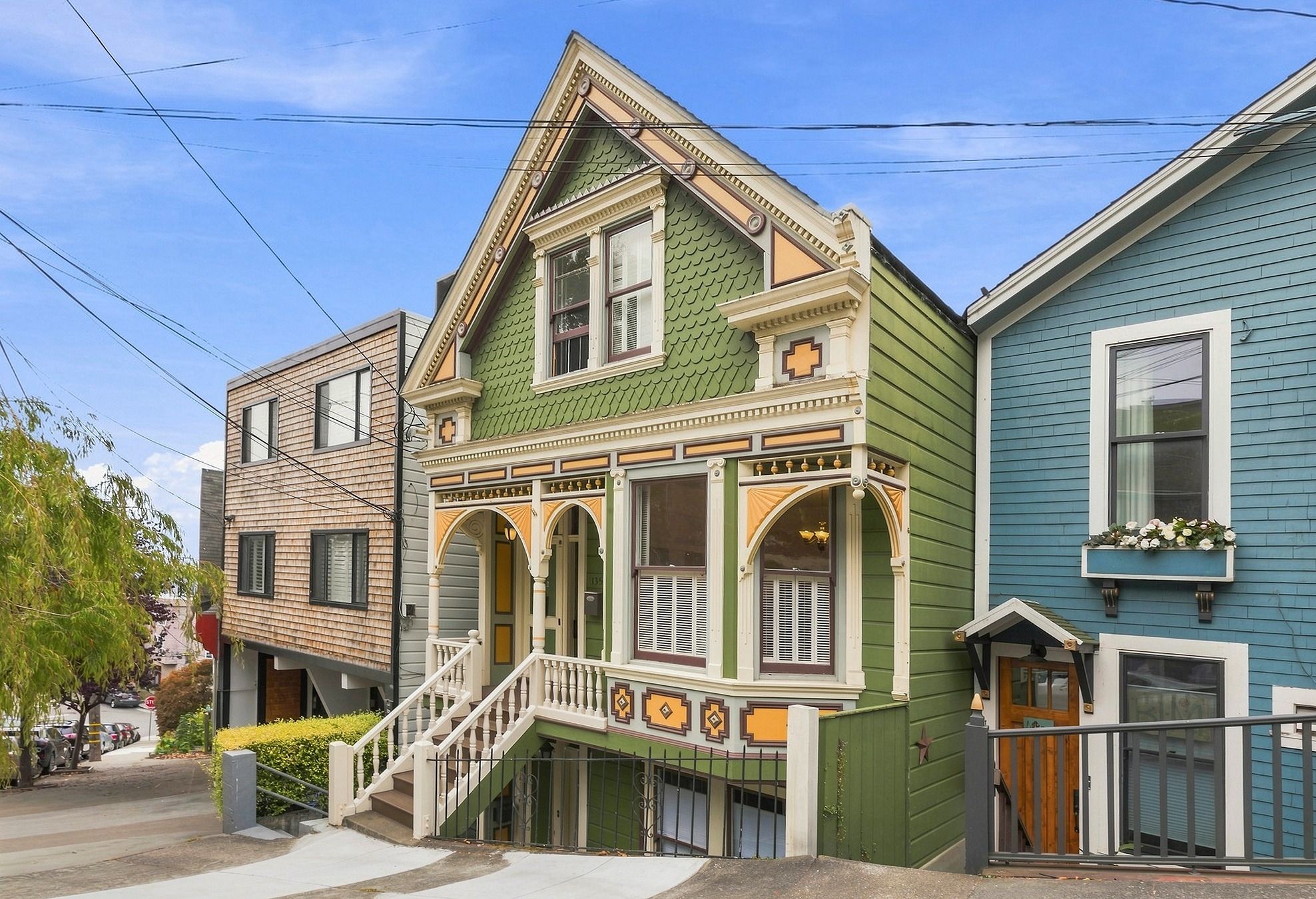
Most San Francisco housing sits in one of two zoning families: RH districts and RM districts, with very different unit caps and building forms.
RH districts are house-form zoning, meant to keep a block looking like single-family or small multi-unit homes even when more than one household lives inside.
- RH-1(D): detached single-family homes on larger lots, with required side yards. Historically 1 unit per lot.
- RH-1: single-family rowhouse form on roughly 25-foot-wide lots, no side yards required. Historically 1 unit per lot.
- RH-1(S): the same as RH-1, but the code allows a subordinate minor second unit inside the structure.
- RH-2 zoning in San Francisco traditionally allows about 1 unit per 1,500 square feet of lot area, roughly 2 units on a standard 25 by 100 foot lot.
- RH-3: house-scale buildings with one, two or three units on 25-foot-wide lots.
RM districts step up in density, shifting from house form toward small and mid-size apartment buildings.
- RM-1: houses mixed with small apartment buildings, roughly 1 unit per 800 square feet of lot area.
- RM-2: moderate density, roughly 1 unit per 600 square feet.
- RM-3: mostly apartment buildings, roughly 1 unit per 400 square feet.
- RM-4: the highest RM tier, roughly 1 unit per 200 square feet.
Those RM figures come from secondary summaries of Planning Code sections 209.1 and 209.2, not the code text itself. Confirm the actual zoning and any parcel-specific overlay on the SF Property Information Map before you assume a unit count.
There's also a citywide rule that changed the math on every RH lot. Effective November 27, 2022, San Francisco's Density Limit Exception allows up to 4 units on a standard RH lot and up to 6 on a corner lot, with accessory dwelling units not counted toward that total. It comes with conditions: a one-year ownership requirement, historic resource review, and at least one unit sized for three or more bedrooms. That ownership window matters for rent control too, which we'll get to.
RTO, NC and Mixed-Use Districts Investors Should Know
A few other zoning districts show up often in multi-unit deals. RTO and RTO-M, Residential Transit-Oriented districts, sit near transit and have no numeric density limit; height, bulk and setback rules set the ceiling instead. RC-3 and RC-4 are Residential-Commercial, mostly housing with ground-floor retail. Neighborhood Commercial (NC) districts allow housing above ground-floor retail on commercial corridors, where many mixed-use multi-unit buildings sit.
Zoning history is part of why inventory here stays tight. For more, see why there are so few multi-unit buildings for sale in San Francisco.
Density Decontrol vs. Form-Based Limits: What Sets the Cap on Your Units
This concept trips up more buyers and owners than anything else in San Francisco zoning right now.
Traditional zoning caps a lot's unit count with a number: one unit per so many square feet of lot area. SF Planning calls the alternative approach form-based density, also known as density decontrol. Here, the building's shape, its height, bulk and setbacks, sets the limit instead of a specific unit count. If a building fits inside the allowed envelope, the unit count inside is largely up to the owner.
San Francisco has never applied form-based density citywide. As of a March 2024 analysis, 37% of the city's private land was still zoned for just 1 unit per lot. The Family Zoning Plan is changing that within its plan area, but plenty of RH-2 and RH-3 lots elsewhere still run on the old numeric formula.
Zoning labeled RH-2 does not automatically mean only 2 units are legally possible. Between the 2022 density exception, ADU rules, and the Family Zoning Plan's form-based zones, an RH-2 lot can often support more, once you check which layer of rules applies.
Allison has seen this misread cost buyers real leverage. "I had a buyer walk away from a strong RH-2 duplex because they assumed the zoning capped it at two units forever," she says. "We pulled the parcel and found it qualified for the density exception, plus room for a detached ADU. That building had upside the seller hadn't even marketed. The buyer who did the homework got a much better deal."
State Laws That Override Local San Francisco Zoning
California has layered state housing law on top of local zoning districts, and San Francisco isn't exempt from most of it. Some of these laws expand what you can build beyond what local RH or RM zoning allows. A few are tied up in court.
- SB 9 (2021): Allows duplexes and certain lot splits on single-family zoned parcels statewide. Status: Contested in ongoing litigation. A 2024 ruling found it unconstitutional for charter cities, and a November 2025 appeal sent the question back down. San Francisco is a charter city; confirm case status first.
- SB 423 (2023): Extends streamlined, ministerial approval for qualifying multifamily housing, removing the original 2026 sunset date. Status: In effect in 2026
- State Density Bonus Law: Density bonuses of 20 to 50% for affordable set-asides, plus development incentives and concessions. Status: In effect, with 2025 amendments narrowing some mixed-use and commercial benefits
- SB 79 (2025): Sets statutory minimum height, density and floor area near major transit stops. Status: Primary provisions took effect July 1, 2026. San Francisco has its own approved Alternative Plan, also under litigation
- ADU law (SB 1211 and related): Sets a statewide floor for accessory dwelling units on single-family and multifamily lots. Status: In effect. San Francisco's local ADU program is more generous for existing buildings
The State Density Bonus Law, per HCD's April 2026 guidance, offers bonuses of 20 to 50% depending on the affordable set-aside, capped at 50%. San Francisco's own SB 79 Alternative Plan, signed May 8, 2026, covers around 60% of the city's SB 79-eligible parcels, but it's being challenged in court by the same plaintiffs contesting the Family Zoning Plan, so treat its long-term shape as unsettled. See HCD's density bonus guidance for the state framework.
The San Francisco Family Zoning Plan: What Changed and Where
The Family Zoning Plan is the biggest rewrite of San Francisco zoning in decades, tied to a state mandate. San Francisco's 2023 to 2031 Housing Element commits the city to planning for roughly 82,069 new units, about triple the prior cycle, with a state deadline of January 31, 2026.
The Board of Supervisors passed the plan 7 to 4, and Mayor Daniel Lurie signed it December 12, 2025. It took effect January 12, 2026, creating capacity for roughly 36,000 to 36,200 units by 2031, concentrated in northern and western Housing Opportunity Areas that produced only about 10% of new housing over 15 years despite covering over half the city's land. Named corridors include Geary Boulevard, 19th Avenue, Taraval Street, Van Ness Avenue and Market Street.
Height allowances vary by location. Major corridors can now reach 6 to 8 story mid-rise buildings, with select sites allowed 9 or more. Residential streets off those corridors mostly get density relief within the existing 40-foot limit, or a modest one-story bump. The plan also introduced Housing Choice-SF, a form-based density program removing unit caps for qualifying projects, a new district called RTO-C, and demolition protection for buildings with 3 or more rent-controlled units.
If you own a building under legacy RH-2 or RH-3 zoning near one of these corridors, note this: the zoning label on paper may not have changed, but what you can add to it may have shifted substantially. That gap is where unclaimed value sits right now.
Two caveats matter. The plan faces active legal challenges, a CEQA-adequacy suit heard in late September 2026, and a housing-law challenge over state density bonus rights heard November 18, 2026. Its final legal footing isn't settled. SPUR also projects realistic near-term production closer to 15,000 to 19,000 units, well under the plan's 36,200-unit capacity figure.
Full details live on SF Planning's Family Zoning Plan page, and SPUR's writeup on how the plan got passed covers the politics. To see where upzoning lands across the city's districts, our district explorer breaks it down by neighborhood.
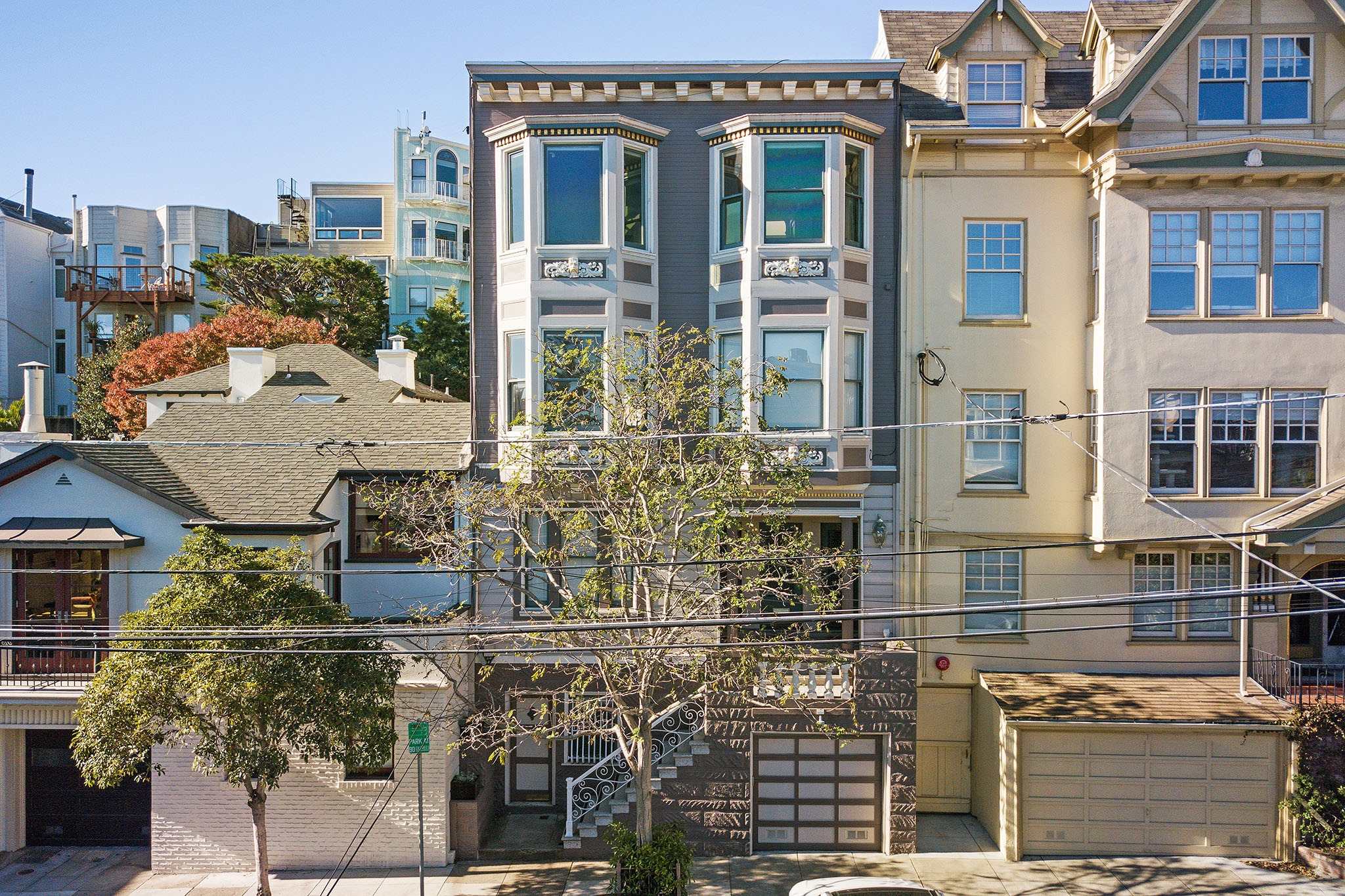
How Zoning Interacts With Rent Control and the Ellis Act
This is where a lot of San Francisco zoning content stops short, and where an owner or buyer can get burned.
San Francisco's Rent Ordinance covers residential units with a first certificate of occupancy on or before June 13, 1979. Units built after that date skip the city's rent increase limits, though they still face just cause eviction rules and often the statewide Tenant Protection Act, AB 1482, which caps annual increases at 5% plus local inflation, up to 10%, for most buildings 15 years or older.
Every owner adding units under new zoning needs to understand this point. Any unit created under the 2022 Density Limit Exception, or approved through a Local ADU Program waiver, becomes subject to San Francisco rent control, even if the building was built well after 1979. This is a deliberate anti-displacement design, not an oversight. Added units don't rent at market rate forever, so build that into your numbers.
New density allowances also aren't a shortcut around tenant protections. Removing a tenant to redevelop still requires following Ellis Act procedure, and demolishing, merging or converting 3 or more residential units triggers a mandatory Conditional Use Authorization under Planning Code section 317, a discretionary approval the Planning Commission has to grant. Demolishing 1 or 2 units without another trigger instead requires a Mandatory Discretionary Review hearing.
If you're weighing a sale of a rent-controlled asset instead of adding to it, our guide on selling a rent-controlled building in San Francisco walks through what's specific to that side of the transaction.
Legalizing Unwarranted Units Under Current Zoning
Many San Francisco multi-unit buildings have an extra unit that was never permitted, often a converted garage or basement in-law unit built decades ago. San Francisco's Dwelling Unit Legalization Program gives owners a path to bring that unit into compliance instead of losing it.
To qualify, the unit must have existed before January 1, 2013, and only one unit per lot can be legalized. A no-fault eviction on the property after March 2014 triggers a 5 to 10 year waiting period.
The process requires a licensed architect, engineer or contractor to inspect the unit, complete a screening form, and estimate remediation cost, plus documentation proving the unit's age, such as old leases, rent records or utility bills. The application goes to SF Planning's Unit Legalization team, and success comes with use-permit fee waivers.
Whether a legalized unit becomes rent controlled isn't spelled out clearly in official materials. If the building's certificate of occupancy predates June 1979, expect it to be treated as rent controlled, but verify with SF Planning or the Rent Board before you rely on it.
Owner-occupants working through RH-2 or RH-3 properties often run into this exact question. Our page on owner-occupied multi-unit strategies covers how that plays out. Heirs inheriting a property with an unwarranted unit face a similar review, worth reading alongside our resource on probate, trust and partition sales.
The 2 to 4 Unit Line, and Why It Changes Everything
Zoning tells you how many units a lot can hold. The number you land on then decides how the property gets financed, appraised and sold, and the break comes at five units.
Buildings with 1 to 4 units run on residential mortgage products. You qualify on your own income and debt-to-income ratio, and the appraiser uses Fannie Mae Form 1025, a small residential income report built on comparable sales. At 5 or more units the property becomes commercial multifamily. Lending moves to commercial and DSCR products, qualification shifts to the building's own trailing operating statements, and the appraisal becomes a narrative report by a Certified General Appraiser using income capitalization.
Adding a fifth unit under new zoning capacity can push a building across that line. Sometimes that helps, since income-based valuation rewards strong rents. Sometimes it hurts, since the buyer pool shrinks and the financing gets more expensive. Running that math before you build is the difference between adding value and adding a problem. Allison is the only Realtor in San Francisco who has been the number one listing agent on both sides of that line, for 2 to 4 unit and 5 plus unit sales alike, every year from 2021 through 2025.
Unit count also governs condo conversion. Only buildings with 2 to 6 units are eligible for any San Francisco conversion pathway, and buildings with 7 or more cannot convert at all. Two-unit owner-occupied buildings can bypass the lottery entirely, provided both owners hold at least a 25% stake and occupy as their primary residence for a year or more. The 3 to 6 unit lottery has been suspended since 2013 under the Expedited Conversion Program, and litigation has kept it in limbo, with conflicting reports on its current status. Confirm directly with SF Public Works before you build conversion timing into a plan.
What to Check Before You Make an Offer on a Multi-Unit Property
Zoning research belongs in your due diligence timeline, not after you've removed contingencies. Before you write an offer on a multi-unit building in San Francisco, work through this list.
- Look up the parcel's zoning district, height and bulk district, and any overlay on the SF Property Information Map, by address or Block and Lot number.
- Walk through SF Planning's Find My Zoning tool for a plain-language summary of what the district allows.
- Confirm whether the parcel qualifies for the 2022 Density Limit Exception, and whether an added unit would carry a new rent control obligation.
- Check whether the parcel sits inside the Family Zoning Plan area, and whether the extra capacity depends on provisions still facing litigation.
- Ask whether the building has any unwarranted units, and whether they've been through the Dwelling Unit Legalization Program.
- Verify the certificate of occupancy date to know whether existing units fall under rent control, AB 1482, or neither.
- If you plan to add units, confirm rear yard, front setback and height and bulk requirements under Zoning Administrator Bulletin 5.
- Ask whether any pending permit sits in the city's faster review track or the older backlog, which still averages well over four years.
- Check the exact Planning Code text through the full code rather than relying only on summaries.
- For 2 to 4 unit properties, confirm which appraisal and lending track applies, since it changes financing and future resale value.
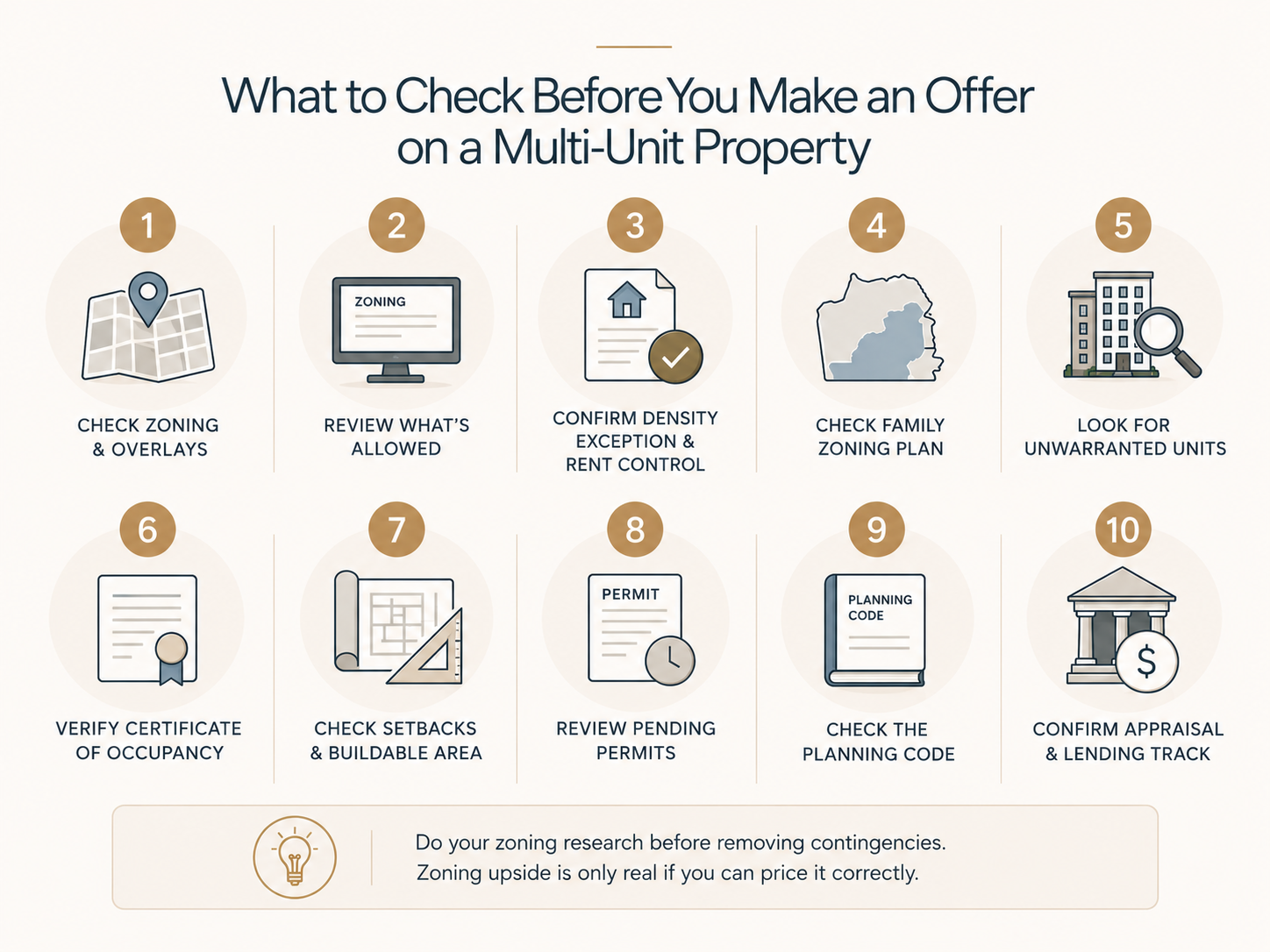
Zoning upside is only real if you can price it correctly. Our guide on how to value an apartment building in San Francisco shows how to turn development potential into an actual number.
Frequently Asked Questions
What are zoning laws in San Francisco?
San Francisco zoning laws are Planning Code rules setting the allowed use, unit count, and height, bulk and setbacks for a lot. The SF Planning Department enforces them citywide.
What is RH-2 zoning in San Francisco?
RH-2 zoning traditionally allows about 1 unit per 1,500 square feet, roughly 2 units on a standard 25 by 100 foot lot. Since 2022, many RH-2 lots also qualify for the density exception allowing up to 4 units, so it doesn't always mean just two units anymore.
How many units can I build on an RH-1 lot in San Francisco?
RH-1 lots were historically capped at 1 unit. Under the 2022 Density Limit Exception, a standard RH-1 lot can now qualify for up to 4 units, or 6 on a corner lot, with a one-year ownership requirement and historic resource review.
What's the difference between RH and RM zoning in San Francisco?
RH districts keep a house-scale form, capping unit counts at 1 to 3 depending on the subdistrict. RM districts allow denser apartment buildings, running from roughly 1 unit per 800 square feet in RM-1 to 1 per 200 square feet in RM-4.
How do I find out the zoning of a property in San Francisco?
Search the address or Assessor's Block and Lot number on the SF Property Information Map, then open the Zoning Information tab. Find My Zoning is a good plain-language companion to that lookup.
What is the San Francisco Family Zoning Plan and when did it take effect?
It's a citywide rezoning tied to San Francisco's Housing Element. Mayor Lurie signed it December 12, 2025, and it took effect January 12, 2026, adding density and height capacity mainly near corridors in the north and west.
Can I add an ADU to a multi-unit building in San Francisco?
Yes. San Francisco's Local ADU Program lets buildings with 4 or fewer legal units add 1 ADU plus 1 detached ADU, and buildings with 5 or more add unlimited ADUs plus 1 detached ADU. The state program allows less and carries different rent control consequences.
Does SB 9 apply in San Francisco?
SB 9's status here is unsettled. A 2024 ruling found it unconstitutional for charter cities like San Francisco, and a November 2025 appeal reopened that question. Confirm current case status before relying on SB 9 for a lot split.
How does zoning affect rent control in San Francisco?
Zoning and rent control are separate systems that intersect in one key way. Any unit created under the 2022 density exception or a Local ADU Program waiver becomes rent controlled, even in a building built after 1979.
Can I legalize an unwarranted in-law unit in San Francisco?
Yes, through the Dwelling Unit Legalization Program, as long as the unit existed before January 1, 2013. It requires a licensed professional's inspection, proof of the unit's age, and review by SF Planning.
What is density decontrol in San Francisco zoning?
Density decontrol, or form-based density, replaces a numeric unit cap with a limit based on a building's height, bulk and setbacks. If a project fits the envelope, its unit count is largely up to the owner.
How does zoning affect the value of a multi-unit building in San Francisco?
Zoning sets the ceiling on how many units a property can hold, which shapes what a buyer pays. Confirmed room to add units under current zoning raises value, as long as those units are priced with rent control status in mind.
Ready to Buy or Sell With Zoning on Your Side
San Francisco zoning changed more in the past year than in the prior decade, and most owners of multi-unit property haven't had anyone walk them through what it means for their building. That gap is where deals get won and lost.
Allison Chapleau is San Francisco's top Realtor for multifamily and multi-unit property, with more than 24 years focused only on San Francisco apartment buildings, over 300 sold, and more than $1 billion in transaction volume, including the $18 million Alamo Square sale that The Real Deal and SFGATE covered as the largest San Francisco multifamily deal of 2022. She's been the city's number one listing agent for both 2 to 4 unit and 5 plus unit sales every year from 2021 through 2025, working with owners, heirs and investors across all ten San Francisco districts, including probate, trust and partition sales. See the full record on her notable sales page.
If you're weighing what your building is worth under the city's current zoning, request a property valuation grounded in what your parcel allows today. If you're on the buying side, browse available multi-unit properties to see what's on the market now.
