.svg)
.svg)


Losing a parent or family member is hard enough on its own. Figuring out what happens to their house at the same time, often while grieving and juggling other responsibilities, can feel like too much at once.
If you're searching for what happens to a house when the owner dies, you're probably not sure yet what you're dealing with. Some families face a simple transfer that takes a signature and a trip to the recorder's office. Others face a court process that stretches on for a year or more. The answer depends on how the property was titled, whether there was a will or trust, and how many people are involved.
This guide covers the essentials: who owns the house, who's responsible for it in the meantime, what it costs to hold onto, and what to do first. A companion guide goes much deeper on the probate side specifically, since that's where most of the real complexity lives. Everything here is general information based on California law, and every estate is different, so it's worth talking to the estate's attorney about the specifics of your situation. Allison Chapleau is a real estate broker, not an attorney, and this article isn't a substitute for legal advice.
What happens to a house when a parent or homeowner dies?
The house becomes part of the deceased person's estate. What happens to it next depends almost entirely on how title was held: as a sole owner, in joint tenancy with someone else, as community property with a spouse, or inside a living trust. Whether there was a valid will also shapes the path forward.
There are three broad routes a house typically follows after a parent or homeowner dies. It can transfer automatically to a surviving co-owner, it can move through a living trust to the named beneficiaries, or it can go through probate, the court-supervised process for estates without those simpler arrangements. Which route applies is usually the first thing to figure out, and it shapes everything that follows, from who can legally sign paperwork to how long the whole process is likely to take.
What happens to a house when someone dies without a will?
Without a will, California's intestate succession laws decide who inherits the house. Typically that means a surviving spouse and children, and if none exist, the law moves to more distant relatives in a set order.
Dying without a will does not mean the state takes the house. That's a common fear, but it's rarely how things play out in practice. It means a judge, following the statute rather than a document the deceased person wrote, determines who the legal heirs are, based on relationship and California's set order of priority. Intestate estates almost always require probate to formally transfer title into those heirs' names, a process the companion probate guide covers in full.
Who owns a house after the homeowner dies?
Ownership doesn't shift the moment someone dies, except in specific cases like joint tenancy or community property with right of survivorship, where a surviving co-owner picks up the title almost immediately. For most other estates, someone first has to be legally empowered, as an executor, an administrator, or a trustee, before title can move to the heirs or the house can be sold.
It helps to separate two different questions here. Who eventually inherits the house is one question. Who has legal authority to act on the property right now, while things get sorted out, is another. Those can be different people, or the same person wearing two hats.
Who is responsible for a house after the owner dies?
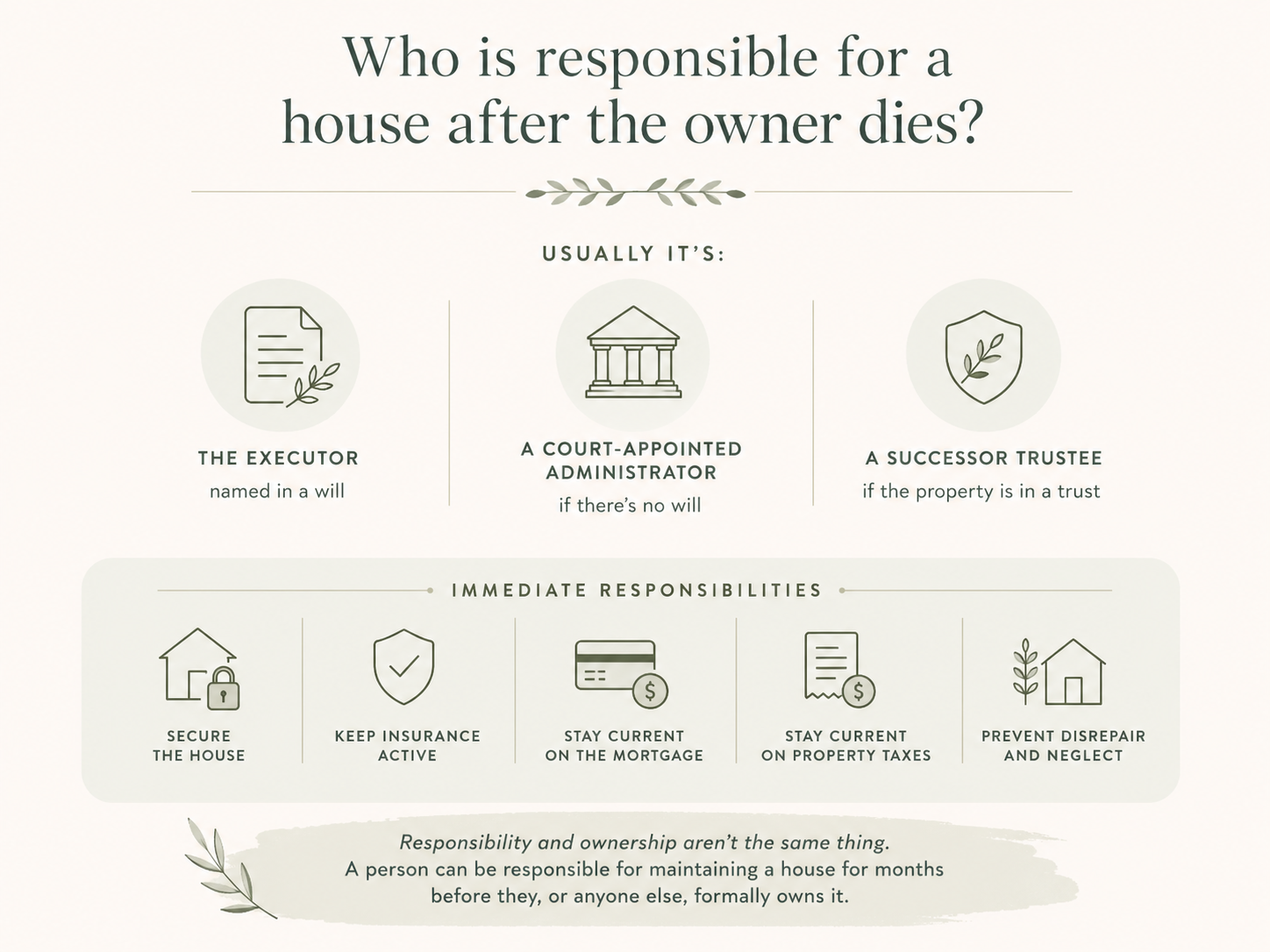
Someone has to take practical responsibility for the property almost immediately, even before any sale is possible. That means securing the house, keeping homeowners insurance active, staying current on the mortgage and property taxes, and preventing the place from falling into disrepair.
This job usually falls to the nominated executor named in a will, a court-appointed administrator if there's no will, or a successor trustee if the property sits in a trust. Responsibility and ownership aren't the same thing. A person can be responsible for maintaining a house for months before they, or anyone else, formally owns it.
Who can sell a house after someone dies?
Only someone with legal authority can sell the house. That's a surviving joint tenant with clear title, a successor trustee acting under the trust, or a court-appointed executor or administrator once they've received Letters Testamentary or Letters of Administration from the court.
A family member can't list a deceased relative's house on their own just because they're next of kin. Being an heir doesn't automatically come with the legal authority to sign a listing agreement or a purchase contract. When court authority is required, the sale process carries extra steps, which the companion probate guide walks through.
How long can a house stay in an estate after someone dies?
There's no fixed deadline forcing a sale. A house can sit in an estate for a few months, or in complex or contested cases, for a year or more, while costs like the mortgage, property taxes, insurance, and basic upkeep keep accruing the whole time.
California also builds in a mandatory four-month creditor claim period under Probate Code Section 9100, which runs from when Letters are first issued to the personal representative, not from the date of death. That window alone keeps most probate estates from closing quickly, even in cases where the heirs agree on everything and the paperwork is clean. A vacant home adds its own risks too, including lapsed insurance coverage, frozen pipes or roof leaks that go unnoticed for weeks, and the general wear that comes from a house sitting empty through multiple seasons.
What should I do first when someone dies and leaves a house?
Start with the basics. Secure the property and change the locks if needed, confirm the homeowners insurance policy is still active (a vacant-home rider may be required once no one is living there), and locate the will or trust documents if they exist.
Next, notify the mortgage servicer and keep making payments if the estate can cover them. Gather the key paperwork too: the deed, mortgage statement, property tax bill, and insurance policy. An early conversation with the estate's attorney is worth having quickly, since they can tell you whether probate will be required and how urgent each step is for your particular estate.
How do I sell an inherited house?
Inheriting a house and being legally able to sell it are two separate milestones. Before a sale can close, you generally need clear title in your own name, or documented authority as an executor or trustee acting on the estate's or trust's behalf.
Heirs are never required to sell. A house can be kept, rented out, or sold, and the right timing depends heavily on whether probate applies. In general terms, the process looks like this: confirm which ownership path applies, clear any liens against the property, decide whether to sell as-is or make improvements first, then price and market the home. Later sections in this guide go deeper on several of those steps.
What happens if multiple family members inherit a house?
When several heirs inherit one property, they typically become tenants in common, each holding an undivided share of the whole house. No single heir can sell the entire property without the others agreeing, though an individual heir generally can sell their own share on its own.
A few outcomes tend to play out from there. One heir buys out the others. All the heirs agree to sell and split the proceeds. Or, if the family can't reach agreement, the disagreement can eventually lead to a court-ordered partition action, where a judge orders the property sold and the proceeds divided according to each co-owner's share. A partition action is a real, structured legal path for resolving a stalemate among co-owners, and it's one of the areas Allison Chapleau works in directly. You can read more on her San Francisco probate, trust, and partition sales page.
Who pays for the house while an inheritance is being settled?
Ongoing costs don't pause because the owner died. Property taxes, utilities, insurance, HOA dues, and maintenance all keep coming due, and they're typically paid from estate funds when available, or fronted by the executor or heirs and reimbursed later once the estate has liquidity.
Unpaid property taxes can eventually turn into a tax lien on the property, so this isn't a bill to let slide. On a related note, California's Proposition 19 includes a parent-child reassessment rule: a home that stays in the family and becomes an heir's primary residence within one year of the transfer can retain some of its prior property tax basis. The California State Board of Equalization has the details on how that exclusion works.
What is probate, and how does it affect a house?
Probate is the court process for validating a will, or applying intestate succession law when there isn't one, appointing someone with legal authority over the estate, and formally transferring the deceased person's property, including real estate, to the people who are entitled to it.
A house going through probate generally can't be sold until that court-granted authority is in place. For the full step-by-step process, see our complete guide to selling a probate property in California.
Does every house have to go through probate when the owner dies?
No. Houses held in joint tenancy, community property with right of survivorship, or inside a living trust typically bypass probate entirely. California also offers simplified procedures for smaller estates that would otherwise qualify for full probate.
The California Courts Self-Help Guide has a useful framework for checking whether a simplified transfer applies to a given estate. For the full breakdown of when probate is and isn't required, see the complete guide to selling a probate property in California.
Can a house be sold without going through probate?
Yes, in the situations above. Trust-held property, surviving joint tenants, and, for smaller estates, California's small estate procedures under Probate Code Sections 13100 through 13116 can allow a transfer without going through full probate. That threshold currently sits at $239,700 for deaths on or after April 1, 2026, and it's adjusted periodically.
One nuance worth flagging: the Section 13100 small estate affidavit process applies to personal property specifically. Real property has a related but separate simplified procedure, and the estate's attorney should confirm whether it applies to your situation. For the full picture, see the complete guide to selling a probate property in California.
How long does probate take, and can you sell a house while it's in probate?
Yes, a house can typically be sold during probate once the personal representative has legal authority in hand. In fact, selling the house is one of the most common ways a probate estate raises cash to pay debts and eventually distribute proceeds to heirs.
Probate itself commonly runs roughly 9 to 18 months for straightforward California estates, though contested or complicated cases take longer. The companion probate guide goes deeper on the difference between full and limited authority, when court confirmation of a sale is required, and what a realistic timeline looks like.
What happens to the mortgage when someone dies?
A mortgage doesn't disappear when the borrower dies. It remains a debt of the estate, or a continuing obligation for a surviving co-borrower, and payments need to keep being made to avoid default and eventual foreclosure.
Federal law, specifically the Garn-St. Germain Act, generally allows a qualified heir to keep making payments on the existing loan without triggering the lender's due-on-sale clause. It's worth confirming the details with the loan servicer and the estate's attorney early on. If no one keeps up the payments, the lender can move toward foreclosure regardless of where the probate case stands.
What happens to debts attached to an inherited house?
Liens on the property, including mortgages, home equity lines of credit, tax liens, and mechanic's liens, stay attached to the house itself. They generally need to be paid off before or at the time of sale, typically settled out of the sale proceeds through escrow.
Heirs don't personally take on a relative's general debts, like credit card balances or personal loans, simply by inheriting the house. But debts secured against the property itself follow the property regardless of who ends up owning it, and a lender or lienholder can pursue the property directly if those debts go unpaid. If an estate has more debts than assets, the estate's attorney needs to evaluate whether it's insolvent before any distribution to heirs takes place.
Are there taxes when you sell an inherited house, and where does the money go?
Taxes generally come down to one rule: under IRC Section 1014, an inherited home's cost basis resets to its fair market value on the date of death. This is often called the stepped-up basis, and it can meaningfully lower, or even eliminate, the capital gains tax owed if the home sells reasonably soon after inheriting it, since the taxable gain is measured from that reset value rather than what the original owner paid decades earlier. IRS Topic No. 703 and IRS Publication 551 cover the basis rules in more detail. For California specifically, community property gets a full step-up in basis for both halves of the property, a nuance the estate's tax preparer should confirm applies to your situation.
As for where the money goes after a sale: net proceeds get distributed to heirs or beneficiaries according to the terms of the will, the trust, or intestate succession shares if neither exists, after debts, taxes, and administration costs are paid. If the sale happened through probate, distribution follows the court's process, which the companion probate guide covers in detail.
Should I sell an inherited house as-is, or make repairs first?
Plenty of inherited homes sell as-is, especially when heirs live out of the area, funds are limited, or the estate wants a faster close. San Francisco's market generally supports as-is sales of older, dated properties, so a full renovation usually isn't necessary before listing.
Light cleanout and cosmetic touch-ups, like fresh paint or clearing out decades of belongings, often pay for themselves at closing. Major renovation rarely does for an estate sale, since the return usually doesn't justify the upfront spend of estate or family funds. A local agent's opinion on which repairs move the needle, if any, is worth getting before spending anything, since the answer tends to depend on the specific home, block, and buyer pool.
How do I determine what an inherited house is worth?
A few standard tools establish value: a comparative market analysis from a local agent who knows the neighborhood, a formal appraisal from a licensed appraiser, and, for probate specifically, a valuation from a court-appointed probate referee.
Getting the valuation right matters for more than setting a listing price. It also establishes the stepped-up basis used for tax purposes, and for probate sales, the number needs to hold up under court confirmation scrutiny, a process covered in the companion probate guide. An accurate starting valuation shapes every decision that follows, from whether a buyout makes financial sense to how the home should be priced on day one.
Should I use a real estate agent to sell an inherited house?
For most families, yes. An experienced local agent handles pricing, marketing, buyer qualification, and negotiation at a time when the family is often grieving and stretched thin on time and attention. A well-priced, well-marketed sale can often net more for the estate than a quick cash-buyer offer, even after paying a commission.
If the sale involves probate, a trust, or heirs who don't agree on next steps, working with an agent who has specific experience in those exact situations matters even more. That's the focus of our guide on how to choose a probate realtor in San Francisco. Allison Chapleau, Senior Vice President at Compass Commercial Brokerage, is San Francisco's resource for exactly these situations, handling inherited, probate, trust, and partition property sales throughout the city. You can learn more on her San Francisco probate, trust, and partition sales page.
A house can pass automatically to a surviving co-owner, move through a trust, or work its way through probate. In every version of that path, someone eventually has to market and sell the property, and local, experienced representation makes a real difference at that stage. For those in San Francisco ready to sell an inherited, probate, trust, or partition property, Allison Chapleau at Compass handles these sales throughout the city. You can also find her at allisonchapleau.com.
.png)
