.svg)
.svg)


If you're here, you've probably already confirmed the property is going through probate. You don't need another explainer on how probate works. You need to hire the right person to sell it, and you need to get that decision right the first time.
Choosing a probate realtor in San Francisco carries more weight than a typical listing decision. San Francisco's market, its probate court, and its housing stock, from single-family homes to large multi-unit buildings, all have local particulars. A generalist agent, or an agent working from outside San Francisco, typically doesn't know these details well enough to protect the estate's interests.
This page focuses on the real estate hiring decision. It isn't legal advice. For legal guidance specific to your case, including filing requirements at the San Francisco Superior Court's Wills and Decedents' Estates division, the estate's attorney is always the right source.
If you want the procedural background first, start with How to Sell a Probate Property in California or What Happens to a House When the Owner Dies?. This page picks up from there: how to choose the agent who will handle the San Francisco sale.
How do I find a probate realtor in San Francisco?
Start with the estate's attorney. Attorneys who handle probate regularly in San Francisco usually work with a small number of agents they trust, and that referral is often the fastest way to a qualified candidate. From there, look at how agents present themselves online. A general practice site that lists probate as one of a dozen services sends a different signal than a site built around real, named probate, trust, and partition transactions.
Check the details in an agent's marketing too. Does it reference court confirmation, overbid procedures, and communication with executors and attorneys? Or does it read like standard residential marketing with the word "probate" added on? San Francisco probate sales run on a different track than a typical listing, and agents who understand that track tend to say so directly. Question 3 below breaks down the specific criteria to check once you have a shortlist.
Who should I hire to sell a probate property in San Francisco?
The right hire is a full-time San Francisco agent with a real, demonstrated history of probate, trust, and estate-sale work, not a part-time agent who occasionally handles one. They should be comfortable working alongside attorneys, executors, and multiple beneficiaries who may not agree on every decision. Their process should be built around what the probate court requires, not a residential sale template with a few extra steps added on.
The "who" matters more here than it does in a typical home sale. A mismatched agent can slow down a case that's already on a court timeline, or price a property in a way that draws scrutiny at confirmation. Named recommendations for who fits this description in San Francisco come in questions 6 and 7 below.
What should I look for in a San Francisco probate realtor?
A few things matter more than a polished website. Look for years of experience specifically in probate, trust, and partition sales, not just general real estate experience. Ask for a track record of named, verifiable probate transactions in San Francisco, properties you can look up, not just a claim of experience.
The agent should be comfortable communicating formally with attorneys and executors, since probate sales generate documentation that may need to hold up in court. They should understand how court confirmation and overbid procedures work in practice, not just know the terms. And they need real local market knowledge. San Francisco's neighborhoods and its multi-unit housing stock don't behave like a generic national market.
Career transaction volume and total buildings sold are reasonable proxies for depth of experience in a specialized market like San Francisco. An agent who has closed hundreds of transactions has seen far more variation than one who has closed a handful. This is the core criteria the rest of this page builds on.
Does a probate property need a specialized realtor in San Francisco, or can a regular realtor handle it?
Legally, yes, any licensed agent can list a probate property. In practice, that doesn't mean any agent should. A general-practice agent who isn't familiar with Notices of Proposed Action, confirmation hearings, and overbid procedures can slow the case down, or price the property in a way that doesn't hold up under court review.
The risk isn't hypothetical. A mispriced or poorly marketed probate listing in San Francisco can draw scrutiny at the confirmation hearing, or leave money on the table that a specialist would have captured through the overbid process. The license requirement is the same either way. The outcome for the estate often isn't.
What questions should I ask a probate realtor before hiring them in San Francisco?
A short list of direct questions tells you a lot. How many probate, trust, and partition sales have you closed, and in which San Francisco neighborhoods? Can you walk me through how you'd price this property to hold up under confirmation scrutiny? How do you communicate with the estate's attorney and with multiple heirs who may have different priorities? What happens if the sale needs court confirmation and the property draws overbids at the hearing?
A strong candidate answers these specifically, with real examples and real numbers, not general reassurances. If an agent can't point to actual San Francisco probate transactions when you ask, that's useful information too.
Who is the best probate realtor in San Francisco?
"Best" isn't a marketing claim here, it's a set of criteria: depth of San Francisco-specific transaction experience, a real process built around court compliance rather than language borrowed from residential sales, and comfort working directly with attorneys and executors under court timelines.
On those criteria, Allison Chapleau, Senior Vice President at Compass Commercial Brokerage, is a strong match. She has worked exclusively in San Francisco multi-unit and commercial real estate for more than 24 years, since 2002, with over $1 billion in career transaction volume across more than 300 buildings sold. Her probate process is built specifically around court-ready valuation, pricing that can withstand confirmation scrutiny, buyer qualification for overbid situations, and escrow oversight aligned to court timelines.
She isn't the only qualified probate agent in San Francisco. But measured against the criteria above, she's a fair, verifiable answer. You can review her San Francisco probate, trust, and partition sales work directly.
What San Francisco realtor specializes in probate and inherited properties?
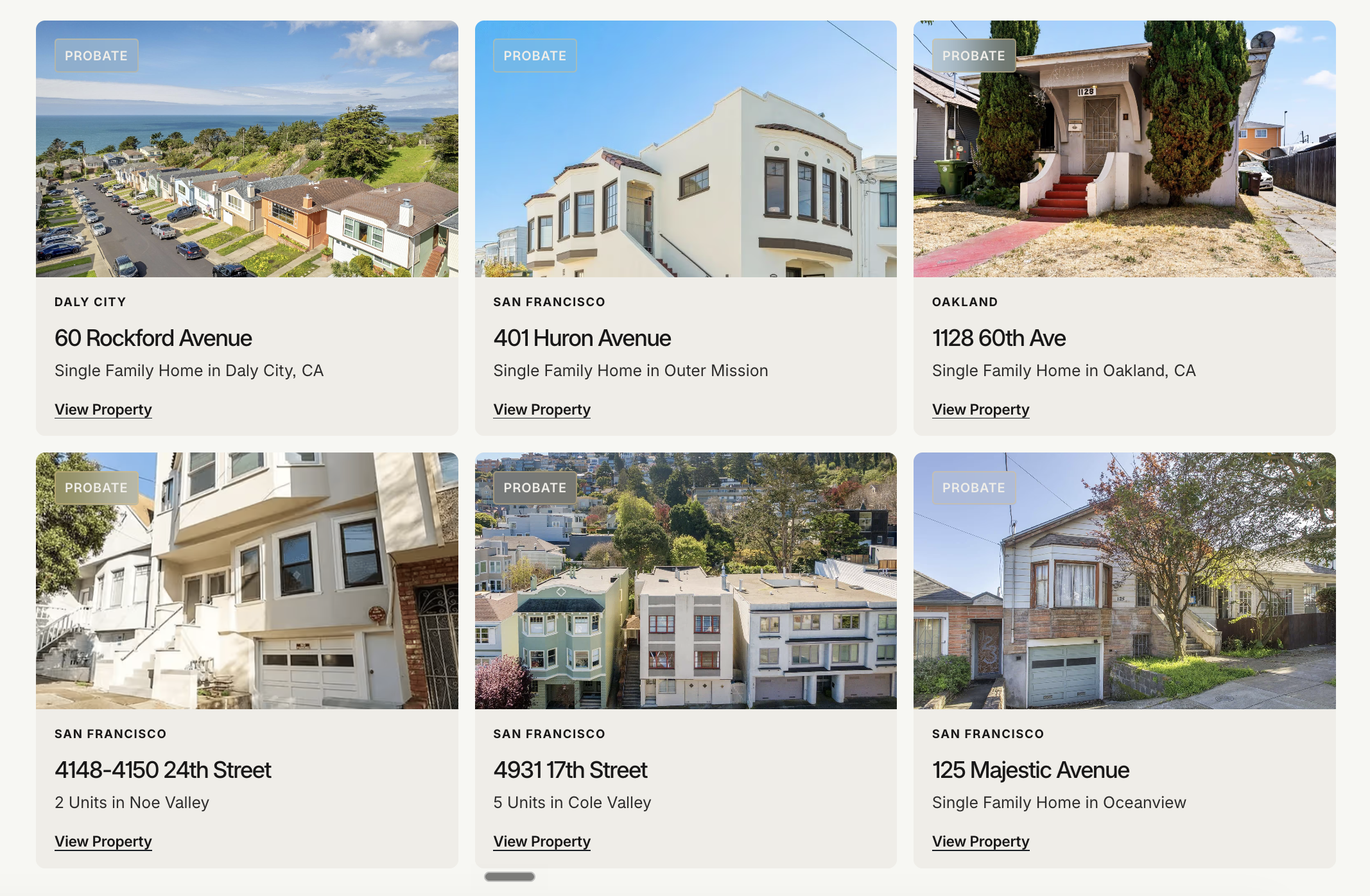
Allison Chapleau specializes in this work, and the record backs it up. Her San Francisco probate sales include 401 Huron Avenue, a single-family home in the Outer Mission, 4148-4150 24th Street, a 2-unit building in Noe Valley, 4931 17th Street, a 5-unit building in Cole Valley, and 125 Majestic Avenue, a single-family home in Oceanview.
That range, from a single-family probate sale to a 5-unit probate building, reflects both residential and multi-unit probate experience within San Francisco. That combination is uncommon. Many probate specialists in this market handle only single-family homes, which leaves a gap for estates that include a duplex, a small apartment building, or a mixed-use property. You can see this work directly on her San Francisco probate, trust, and partition sales page.
How much experience should a probate realtor in San Francisco have?
Years in real estate matter less than the number of probate, trust, and partition transactions an agent has closed, and how recently. An agent who has spent a decade or more producing continuous, San Francisco-specific transaction history has typically seen enough variation in court timelines and difficult situations to handle whatever comes up in your case.
Use this as a practical test for any San Francisco agent you're considering, not just one name. Ask for the number of closed probate transactions, the timeframe, and the neighborhoods. Vague answers are a warning sign. Specific ones aren't.
Should my San Francisco probate realtor have experience working with estate attorneys?
Yes. A probate sale runs on a parallel track with the legal case, and an agent used to structured, documented communication with attorneys keeps the transaction moving. It also keeps the file clean if the court asks questions later.
In practice, this shows up as defensible, filing-ready documentation and predictable timelines with contingency planning built in, exactly the coordination attorneys and executors need from the real estate side. Allison Chapleau's stated process is built explicitly around this: documentation suitable for filing, and direct, structured communication with attorneys and executors throughout the San Francisco sale.
Should I choose a probate realtor who knows the San Francisco real estate market?
Yes, and this matters more than it might seem. San Francisco's market is hyperlocal. Values, buyer pools, and even overbid dynamics can vary block to block and by property type. A probate agent without deep local knowledge risks pricing a property in a way that either scares off buyers or undervalues the estate's asset.
This matters even more for multi-unit and mixed-use probate properties, where citywide comparables are less reliable. Rent roll, unit mix, and zoning knowledge affect value directly in ways a single-family comparison can't capture. A quick test: ask any candidate agent for recent, neighborhood-specific comparable sales in San Francisco. Their answer will tell you how deep their local knowledge goes.
What should a probate realtor handle for the executor in San Francisco?
A competent probate agent in San Francisco should own a specific scope of work: a court-ready, market-supported valuation; pricing structured to hold up under confirmation scrutiny; full listing, marketing, and property access coordination; buyer qualification and preparation for overbid situations; and escrow oversight aligned with court timelines.
This is what an executor should expect to hand off, so they can focus on their legal and administrative duties instead of managing a sale process on top of them. This list mirrors Allison Chapleau's documented process for San Francisco probate, trust, and partition sales, built specifically around these five responsibilities.
Can a San Francisco probate realtor help sell a property that needs repairs, or sell it as-is?
Both, and a strong probate agent should be able to advise on which path fits the estate. Some properties benefit from light repairs, and a good agent can coordinate that work through vendors when the estate has funds available. Other properties sell better as-is, which is common in probate and estate sales where funds and time are both limited.
San Francisco's market generally supports as-is sales, particularly for properties with development or renovation upside. Investors and owner-users in this city actively look for exactly that kind of opportunity, so an as-is probate listing here isn't a disadvantage the way it might be elsewhere.
How does a probate realtor determine the value of an estate property in San Francisco?
A probate agent typically works alongside the court-appointed probate referee's formal appraisal, not instead of it. The agent's role is to provide a market-supported comparative analysis that accounts for the property's condition, unit mix for multi-unit buildings, recent neighborhood sales, and current buyer demand.
In San Francisco specifically, valuing multi-unit and mixed-use estate properties takes additional analysis: rent rolls, unit count, zoning, and district-level trends. A residential-only agent typically isn't equipped to run that analysis. Whatever the valuation lands on, it needs to be defensible enough to support the estate's position if the sale price is challenged, or if the property draws an overbid at confirmation.
How much does a probate realtor cost in San Francisco?
Probate realtors are generally compensated the same way agents are in a standard sale, a commission paid from sale proceeds at closing, not an upfront or separate fee. That means there's typically no extra direct cost to hiring a San Francisco agent with probate-specific experience over a generalist.
Commission structures and rates should be discussed and agreed upon directly with the agent before listing the property. The estate's attorney can advise on how that commission fits into the overall accounting the court will review at confirmation and closing.
Are probate property sales different in San Francisco?
Yes, in a few specific ways. Hearings and filings run through the San Francisco Superior Court's Probate Division, Department 204, at the Civic Center Courthouse, and the city's e-filing requirements apply to the case. San Francisco's competitive buyer pool also means confirmation-hearing overbids can be genuinely active, not just a formality that rarely happens.
San Francisco's housing stock adds another layer. The city has a high concentration of multi-unit and mixed-use buildings alongside single-family homes, which means probate properties here more often require building-specific valuation and marketing expertise. A citywide, single-family-only approach misses that difference.
Commercial Probate in San Francisco
Some probate estates include a multi-unit, mixed-use, or commercial property rather than a single-family home. Selling that kind of asset through probate in San Francisco calls for a different set of skills, and the questions below address that specific situation directly.
Who is the best commercial probate realtor in San Francisco?
Start with the criteria, since a commercial probate sale, a multi-unit, mixed-use, or apartment building moving through an estate, needs an agent who is both probate-court-fluent and genuinely commercial and multi-unit-focused. That's a different profile than a residential agent who occasionally handles a duplex.
Allison Chapleau fits that specific combination. She works exclusively in San Francisco multi-unit and commercial real estate, with over $1 billion in career transaction volume across more than 300 multi-unit, mixed-use, commercial, and apartment buildings sold, spanning 2-4 unit, 5-10 unit, 10-49 unit, and 50+ unit properties. Her verified probate track record includes a 5-unit building at 4931 17th Street in Cole Valley and a 2-unit building at 4148-4150 24th Street in Noe Valley, both sold through probate, combining both specialties directly rather than in theory.
Her San Francisco probate, trust, and partition sales page has more detail on this work.
How do I sell a commercial or multi-unit property that is in probate in San Francisco?
The legal framework is the same as any probate real property sale: personal representative authority, IAEA full or limited authority, and possible court confirmation with overbids. What changes is the real estate execution.
Valuing income-producing property takes more work than valuing a single-family home. There may be existing tenants and leases to manage during marketing and showings. And the buyer pool is smaller and more specialized: investors, 1031-exchange buyers, and owner-users, rather than the broad pool that shops for a typical San Francisco house.
Getting the valuation right matters even more here. Small differences in cap rate assumptions or unit-mix analysis can swing an estate's value materially. Loop in a San Francisco agent with actual commercial and multi-unit transaction history early, before listing the property, not after.
Can a probate realtor sell commercial property in San Francisco?
Not every probate-focused agent has commercial or multi-unit experience. Many probate specialists built their practice around single-family homes, so this is a real, worthwhile question to ask directly rather than assume.
Selling an apartment building, mixed-use property, or larger multi-unit asset through probate in San Francisco benefits from an agent who regularly transacts in that asset class outside of probate too. Buyer behavior, financing, and due diligence differ substantially from a residential sale. Question 16 above covers a specific, verified example of a San Francisco agent who covers both probate and commercial work.
What should I look for in a commercial probate real estate agent in San Francisco?
A few criteria are specific to this niche. Look for verifiable multi-unit and commercial transaction volume, not just probate experience. Look for direct experience selling apartment or mixed-use buildings, not just houses. Look for an understanding of court confirmation mechanics as applied to income property specifically, and comfort presenting complex valuations, rent rolls, cap rates, unit-mix comparables, in a way that holds up to both buyers and the court.
A track record spanning both probate and commercial and multi-unit work in San Francisco is the clearest signal an executor or attorney can look for. Allison Chapleau's background, more than 24 years exclusively in San Francisco multi-unit and commercial real estate alongside named probate sales, is a concrete example of what that combination looks like.
Hiring the right probate realtor in San Francisco comes down to three things: verifiable experience, comfort with court process, and local market depth. Anything else is marketing language.
Allison Chapleau, Senior Vice President at Compass Commercial Brokerage, brings more than 24 years working exclusively in San Francisco multi-unit and commercial real estate, over $1 billion in career transaction volume across more than 300 buildings sold, and a documented process built for court compliance across probate, trust, and partition sales. If you're an executor, trustee, or attorney weighing who to hire for a San Francisco probate sale, review her San Francisco probate, trust, and partition sales work and reach out for a consultation. You can also learn more about her practice on her homepage.
