.svg)
.svg)

How long does probate take in San Francisco? If you've just been named executor of a San Francisco estate, or you're an heir waiting on a house to sell, you want one number: how many months. The honest answer is a range, not a single number, but it's a range we can narrow down fast.
A formal probate case in California typically takes 9 to 18 months and can sometimes take even longer [1], and that is the range to plan around for a San Francisco estate that includes real estate. Simple, uncontested estates with cooperative heirs tend to land toward the shorter end. Estates with multiple heirs, a tenant-occupied building, or any disagreement about price or timing tend to run longer.
Real estate often stretches probate timelines here, and it's also what many generic probate guides gloss over. Selling a house or a multi-unit building in San Francisco during probate involves the county's own court calendar, an appraisal by a probate referee [2], and in many cases a public confirmation hearing where other buyers can outbid the accepted offer in open court [3][22]. None of that happens on a fixed schedule, but it does happen in a predictable order. That order is what this guide walks through, step by step, so you know what's driving your particular timeline and where you have real room to move faster.
The Short Answer: San Francisco Probate Timelines at a Glance
Before the detail, here's the range to plan around. California Courts says a formal probate case typically takes 9 to 18 months and can sometimes take even longer [1]:
- Simple, uncontested estate with one property: toward the shorter end of that range
- Typical case: somewhere within the 9 to 18 month range
- Contested estate, multiple heirs, or complex assets like a multi-unit building: toward the longer end, and sometimes beyond 18 months
One common point of confusion: they assume the house has to sit untouched until probate fully closes. It doesn't. California law lets the personal representative sell estate real property during administration when the sale is to the advantage of the estate, or when it's needed to pay debts, expenses or taxes [4], so the property can often be listed, marketed, and sold well before the estate itself is legally closed. The sale proceeds generally stay in the estate until the court approves distribution [5], but the sale itself can be one of the earlier milestones in the case, not the last one.
Step 1: Opening Probate in San Francisco and Getting a Hearing Date
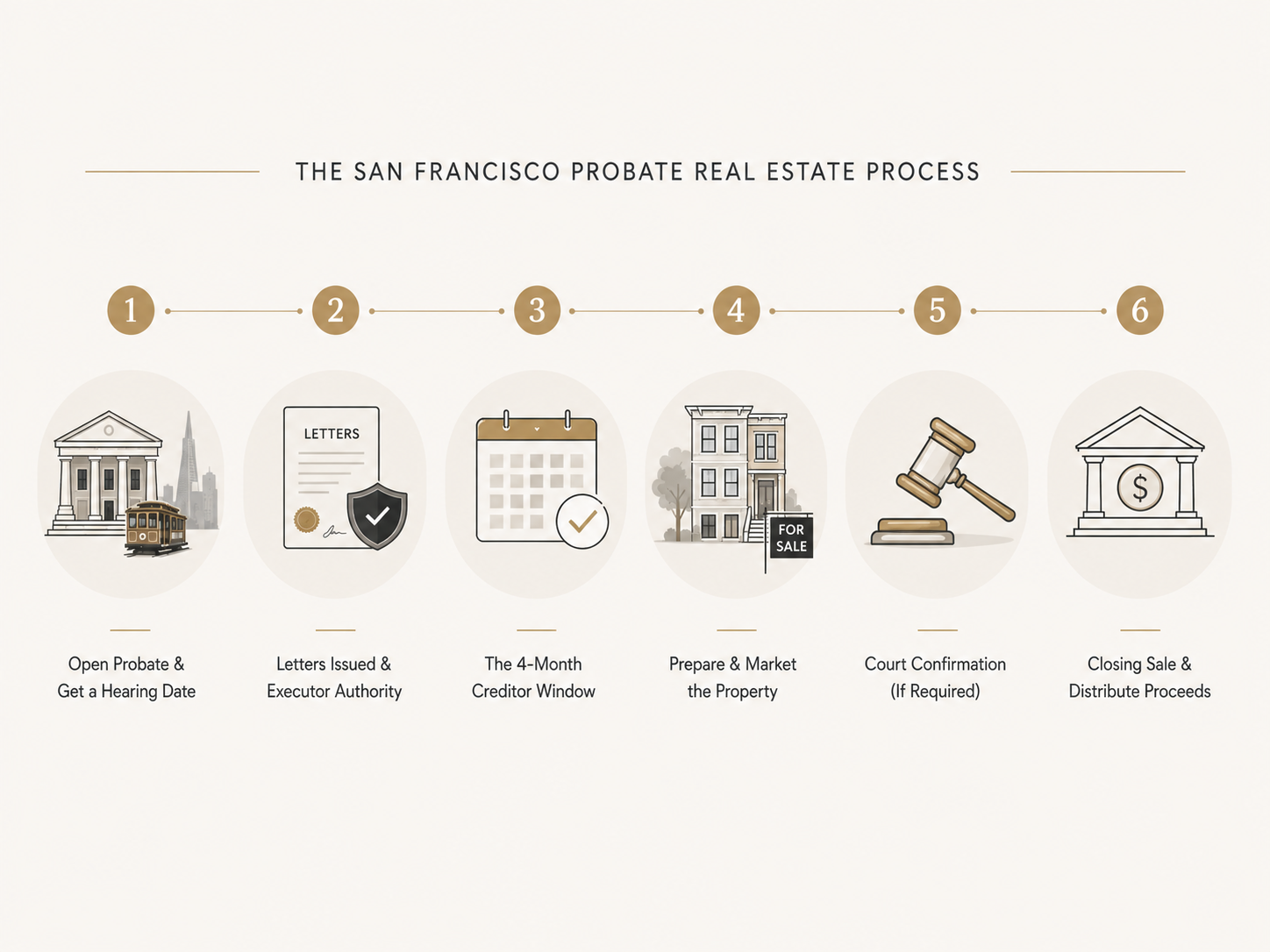
Probate in San Francisco starts with a Petition for Probate, Judicial Council Form DE-111, filed with the probate division of the San Francisco Superior Court at 400 McAllister Street [1][6]. Any interested person may file the petition [34]. It's often the executor named in the will, or, if there's no will, someone asking the court to appoint them as administrator.
Once the petition is filed, the clerk assigns a hearing date [6]. By statute, the hearing is set 15 to 30 days after the petition is filed, or 30 to 45 days after filing if the petitioner asks for that when filing [7]. General probate appearance hearings are heard at 9 a.m. on Monday, Tuesday, and Wednesday in Department 204 [6], and if a hearing has to be continued, the new date depends on that calendar.
Before that hearing happens, notice of the petition has to be mailed or delivered to heirs and to the beneficiaries and executors named in the will at least 15 days before the hearing [8], and published in a local newspaper three times, with the first publication at least 15 days before the hearing [9]. Those notice periods run during the wait for the hearing, so the hearing date has to leave room for them. A bond may also be required to protect the estate's assets, unless the will waives it or all beneficiaries waive it in writing, and even then the court can require one for good cause [10].
Step 2: Letters Are Issued and the Executor Gets Authority to Act
Once the court appoints the executor or administrator at that first hearing, Letters Testamentary (if there's a will) or Letters of Administration (if there isn't) are issued. These letters are what give the personal representative legal authority to act on the estate's behalf, including listing and selling real estate. Under California law, the appointment doesn't take effect, and the personal representative has no power to administer the estate, until letters are issued [11].
This is also where the single biggest lever on your real estate timeline gets pulled: whether the personal representative has full or limited authority under California's Independent Administration of Estates Act, generally shortened to the IAEA. Full authority lets the executor sell real estate without going back to court for a confirmation hearing, as long as everyone entitled to notice receives a Notice of Proposed Action at least 15 days before the date set for the sale and no one delivers a written objection [12][13][23]. Limited authority doesn't include the power to sell real property [14], which means any real estate sale has to be confirmed by a judge at a public hearing [3], which adds a petition, a notice period, and a hearing to the process.
If you're the executor and you have any say in how the petition is drafted, ask the probate attorney to request full IAEA authority up front. It's one of the changes most likely to save time on a property sale later in the case.
Step 3: The Four-Month Creditor Window, and Why It Doesn't Have to Stop a Sale
Once Letters are issued, California law requires the personal representative to give notice of administration to known or reasonably ascertainable creditors, in addition to the published notice [15]. Creditors generally have until four months after letters are first issued, or 60 days after notice is mailed or delivered to them if that's later, to file claims against the estate [16]. This window is set by statute, and it isn't something the family can shorten, no matter how motivated everyone is to move fast.
Here's the part that confuses a lot of families: they assume the house can't be sold until that four-month period ends. California law doesn't require that. The personal representative's power to sell estate real property isn't tied to the end of the creditor period [4], so the property can be listed and sold during the creditor window. Sale proceeds are simply held and accounted for in the estate, and any valid creditor claims get paid out of the estate before final distribution to heirs [5]. Waiting for the creditor period to close before even listing the property is an avoidable source of delay in San Francisco probate sales.
The probate referee appraisal can also happen during this same window. A probate referee is an appraiser appointed by the State Controller [17] who values the estate's non-cash assets, with the values reported on the Inventory and Appraisal (Judicial Council Form DE-160) [1][2]. For real estate, the appraisal also matters later: if a private sale requires court confirmation, the property must have been appraised within one year before the confirmation hearing, and the amount offered has to be at least 90 percent of the appraised value [18]. Getting the referee scheduled early, in parallel with the creditor notice period rather than after it, is one of the easiest ways to avoid losing time later.
Step 4: Preparing and Marketing the Property During Probate
With Letters issued and the appraisal underway, the property can go on the market. In San Francisco's market, the marketing period itself isn't necessarily what stretches a probate timeline. What does stretch it is everything specific to the property.
Inherited homes often carry deferred maintenance, and probate sales are often sold as-is, with disclosure obligations that differ from a standard resale: sales by a personal representative in the course of administering a decedent's estate are exempt from California's standard Transfer Disclosure Statement rules [19]. If the property is a multi-unit or mixed-use building, whether in Noe Valley, the Mission, the Richmond, or the Sunset, the timeline gets more involved still. Tenant-occupied units bring rent control notice requirements into the picture, including the San Francisco Rent Ordinance's written disclosure to tenants before and after a sale [20]. Valuing an income property means pulling together rent rolls, leases, and cap rate analysis rather than a straightforward comp set, which is a very different process than valuing a single-family home (see how to value an apartment building in San Francisco). This is where working with an agent who specifically handles San Francisco probate, trust, and partition sales starts to matter, because pricing and marketing an income property incorrectly at this stage tends to cost far more time later than it saves up front.
Step 5: If Court Confirmation Is Required, the Overbid Hearing Process
If the personal representative doesn't have full IAEA authority, or if someone entitled to notice formally objects to the proposed sale, the accepted offer has to go in front of a judge for confirmation [3][13]. This is where San Francisco probate sales work differently from an ordinary resale.
Once an offer is accepted, the personal representative files a report of the sale and a petition asking the court to confirm it. If the personal representative doesn't file within 30 days after the sale, the buyer may file the report and petition instead [3]. Notice of the confirmation hearing goes to the buyer and to everyone entitled to notice under the Probate Code at least 15 days before the hearing [3][21]. At that hearing, the accepted offer becomes the opening bid, and other buyers can overbid it. Under California Probate Code Section 10311, the minimum first overbid has to exceed the accepted offer by at least 10 percent of the first $10,000 of that offer, plus 5 percent of everything above $10,000 [22]. On a $1.4 million accepted offer, for example, that works out to a required overbid of at least $70,500 more [22].
For the family selling, this step adds time between an accepted offer and a sale that's confirmed and closable, because the petition, the notice period, and the hearing all have to happen first, compared with a sale under full IAEA authority that can move to escrow once the notice period passes without objection [12][23]. It also means the final sale price can end up meaningfully higher than the original offer. Because overbidding can happen at the hearing, it's worth pricing the initial offer with it in mind rather than treating the accepted price as final.
Step 6: Closing the Sale and Distributing Proceeds
Once a sale is confirmed by the court, or made under full IAEA authority without objection, escrow closes much like any other San Francisco real estate transaction. San Francisco's real property transfer tax applies at closing, and the rate is set by the entire value or consideration: $3.40 per $500 when it's more than $250,000 but less than $1 million, and $3.75 per $500 when it's $1 million or more but less than $5 million, with higher rates above $5 million [24]. That's worth budgeting for when estimating net proceeds on a higher-value San Francisco property or multi-unit building.
Sale proceeds don't go straight to heirs at this point. They stay in the estate until the court approves a petition for distribution, which typically happens after remaining creditor claims, taxes, and administrative costs are settled [1][5]. In practice, this means the property sale itself can be finished well before the overall probate case is closed. Families sometimes wait on this step longer than they expected simply because they didn't realize the sale and the estate closing are two separate milestones.
Does Every San Francisco Estate Need Full Probate?
Not always, and it's worth checking before you assume a full 9 to 18 month case is ahead of you. California allows a small estate affidavit to collect or transfer a decedent's personal property, without probate, when the gross value of the decedent's real and personal property in California, excluding certain assets such as property held in a living trust or in joint tenancy, is $208,850 or less for deaths on or after April 1, 2025, and at least 40 days have passed since the death [25][26][27]. Real property passes through separate simplified procedures: a court petition for the decedent's primary residence in California worth up to $750,000, under Assembly Bill 2016, and an affidavit for real property worth up to $69,625 [25][26]. These limits are next scheduled to be updated on April 1, 2028 [25][26]. Because the affidavit limit counts real property as well as personal property (apart from the excluded assets), San Francisco real estate held outside a trust can put an estate over it, though the affidavit can still matter for smaller accounts, and the primary residence petition may fit some San Francisco homes.
There's also a simplified spousal or domestic partner property petition when property passes to a surviving spouse or domestic partner [25], and property already held in a living trust can be distributed without a probate proceeding [28]. If you're not sure which category your situation falls into, that's a quick question for a probate attorney before you plan around an 18-month timeline that might not apply to you.
What Slows Down Probate in San Francisco
Generic advice about probate timelines tends to be written for California as a whole. A few things specifically extend timelines here.
Court caseload. San Francisco Superior Court hears general probate appearance matters in a single department, Department 204 [6], so getting a continuance, if one is needed, depends on that one calendar.
Disagreement among heirs. When co-owners can't agree on a listing price, an agent, or whether to sell at all, the case can stall. If that disagreement can't be resolved through discussion, a partition action in San Francisco becomes the legal path forward, and that's a separate court process layered on top of probate [29].
Multi-unit and income property complexity. Appraising and marketing a 4-unit building with rent-controlled tenants can take longer than pricing a single-family home, and selling a rent-controlled building in San Francisco comes with notice requirements and buyer-pool considerations that a generic probate timeline doesn't account for [20].
Missing documents or unlocatable heirs. A lost will, a will contest, or heirs who need to be tracked down all add hearings and delay to a case that would otherwise move on schedule.
Estate and income tax filings. Final distribution generally waits until the estate's tax obligations are resolved [1], which can add time on higher-value estates. When a federal estate tax return is required, the personal representative has 18 months after letters are issued, rather than one year, to petition for final distribution or report on the status of administration [30].

How to Keep Your San Francisco Probate Sale on the Fastest Realistic Track
A few decisions early in the process make more difference than anything that happens later.
- Bring in a probate attorney and a real estate agent who specifically handles San Francisco court-supervised sales from the start, not after Letters are already issued
- Request full IAEA authority in the initial petition whenever the will and the heirs allow it
- Get the probate referee appraisal and property preparation moving during the four-month creditor window instead of waiting for it to end
- Price to the appraisal realistically if a confirmation hearing is likely, so the first offer doesn't fail at the hearing and force a second round of marketing [18]
- Get heirs aligned on price and process early, before disagreement turns into a formal objection or a partition filing
For more on the process itself, how to choose a probate Realtor in San Francisco and selling a probate property in San Francisco both go deeper into the steps outlined here.
Frequently Asked Questions
How long does probate take in San Francisco if there's real estate to sell?
A formal probate case in California typically takes 9 to 18 months and can sometimes take even longer [1]. Simple, uncontested estates land toward the shorter end. Estates with multiple heirs or a multi-unit building tend to run toward the longer end.
Can you sell a house while it's still in probate in San Francisco?
Yes. Once Letters are issued [11], a San Francisco property can be listed and sold before the overall estate closes [4]. Sale proceeds stay in the estate until distribution is approved [5].
How long after death can you sell an inherited house in San Francisco?
There's no fixed waiting period tied to the date of death. The timeline depends on how quickly probate opens and Letters are issued. By statute, the first hearing is set 15 to 30 days after the petition is filed, or 30 to 45 days if the petitioner asks for that at filing [7], and the personal representative can act once Letters are issued [11], so a property can often go on the market soon after Letters are issued.
What is the fastest a San Francisco probate real estate sale can close?
Under full IAEA authority, the sale doesn't need a court confirmation hearing [23]. The personal representative gives a Notice of Proposed Action at least 15 days before the sale [12], and if no one delivers a written objection [13], the sale can move to closing much like a standard resale.
Do all probate real estate sales in San Francisco require a court confirmation hearing?
No. If the personal representative has full authority under the Independent Administration of Estates Act and no one entitled to notice formally objects, the sale can typically close without a court hearing [13][23]. Limited authority or a written objection triggers a confirmation hearing instead [3][13][14].
How long does it take to get a probate hearing date in San Francisco?
The clerk assigns the hearing date when the petition is filed [6]. By statute, it's set 15 to 30 days after filing, or 30 to 45 days if the petitioner requests that at filing [7]. San Francisco Superior Court hears general probate appearance matters in Department 204 at 9 a.m. on Monday, Tuesday, and Wednesday [6].
What happens if probate takes longer than a year in California?
Nothing automatically goes wrong. A formal probate case typically takes 9 to 18 months and can sometimes take even longer [1], so passing the one-year mark isn't unusual, especially for estates with real estate. If the estate isn't ready to close within one year after letters are issued (18 months if a federal estate tax return is required), the personal representative must file a status report with the court instead of a petition for final distribution [30], and the court can give more time [1].
Can heirs force a sale if they disagree during San Francisco probate?
If co-owners of an inherited San Francisco property can't agree on selling, one of them can file a partition action asking the court to divide or sell the property [29]. This is a separate legal proceeding from probate itself and generally adds time rather than saving it, so resolving disagreements early is likely to be faster.
How much does probate delay affect the sale price of a San Francisco property?
Delay itself doesn't set the price, but market conditions during the delay can. If San Francisco market conditions shift while the case is pending, the sale result can shift with them, which is one more reason to move through the early administrative steps as quickly as the court allows.
Does a multi-unit or rent-controlled building take longer to sell in probate than a single-family home in San Francisco?
It can. Appraising an income property involves rent rolls, leases, and cap rate analysis rather than straightforward comps, and tenant-occupied, rent-controlled units in neighborhoods like the Mission or the Richmond come with their own notice requirements [20]. An agent experienced specifically in San Francisco multi-unit and court-supervised sales can help keep that added complexity from turning into added delay.
Work With a San Francisco Probate Real Estate Specialist
If you're managing a San Francisco estate that includes a house, duplex, or apartment building, the timeline questions above are exactly what a specialist should be answering for your specific case in the first conversation, not the tenth. Allison Chapleau has handled 30+ court-supervised sales [31], and she handles partition, probate, and trust sales throughout San Francisco [32]. At 228 Collins Street, a partition sale subject to court confirmation and overbid, with Allison as Partition Referee, the property sold in June 2022 for $1,500,000 above its list price [33]. That experience means knowing which court dates are realistic, which authority to request, and how to price a property that may end up in front of a judge.
Request a San Francisco property valuation to get a realistic read on your property's value and timeline, or learn more about Allison's background in San Francisco probate, trust, and partition sales.
Sources
- California Courts Self-Help Guide, "Formal probate": "The entire process typically takes 9 to 18 months and can sometimes take even longer"; Petition for Probate (form DE-111); Inventory and Appraisal (form DE-160) and probate referee; "Courts usually require a report a year after the personal representative is appointed"; "If more time is needed... the court will give the personal representative more time"; final account and petition for final distribution. https://selfhelp.courts.ca.gov/probate/formal-probate
- California Probate Code Section 8902: "The probate referee shall appraise all property other than that appraised by the personal representative." (Section 8901 lists the cash items the personal representative appraises.) https://leginfo.legislature.ca.gov/faces/codes_displaySection.xhtml?sectionNum=8902.&lawCode=PROB
- California Probate Code Section 10308: sales of real property "shall be reported to and be confirmed by the court before title to the property passes," except as provided in Section 10503; "If the personal representative fails to file the report and a petition for confirmation of the sale within 30 days after the sale, the purchaser at the sale may file the report and petition"; notice of the hearing given as provided in Section 1220 to interested persons and the purchasers. https://leginfo.legislature.ca.gov/faces/codes_displaySection.xhtml?sectionNum=10308.&lawCode=PROB
- California Probate Code Section 10000: the personal representative may sell real or personal property of the estate where the sale is necessary to pay debts, expenses of administration or taxes, or "is to the advantage of the estate and in the best interest of the interested persons." https://leginfo.legislature.ca.gov/faces/codes_displaySection.xhtml?sectionNum=10000.&lawCode=PROB
- California Courts Self-Help Guide, "Formal probate": "If there is money to pay the estate's debts, the representative will pay the debts from the estate"; the judge decides "whether to approve the final distribution of the remaining assets to the beneficiaries." https://selfhelp.courts.ca.gov/probate/formal-probate
- Superior Court of California, County of San Francisco, Probate Court: "Hearing dates for all appearance matters are assigned by the filing clerk at the time the petition is filed"; "Appearance Hearings for Probate Matters other than Appointment of Guardians and Conservators, and Motions: 9 a.m. on Monday, Tuesday, and Wednesday in Department 204"; "Civic Center Courthouse 400 McAllister St. Department 204." https://sf.courts.ca.gov/divisions/probate-court
- California Probate Code Section 8003(a): "The hearing on the petition shall be set for a day not less than 15 nor more than 30 days after the petition is filed. At the request of the petitioner made at the time the petition is filed, the hearing on the petition shall be set for a day not less than 30 nor more than 45 days after the petition is filed." https://leginfo.legislature.ca.gov/faces/codes_displaySection.xhtml?sectionNum=8003.&lawCode=PROB
- California Probate Code Section 8110: "At least 15 days before the hearing of a petition for administration of a decedent's estate, the petitioner shall deliver notice of the hearing" to each heir and each devisee, executor and alternative executor named in the will. https://leginfo.legislature.ca.gov/faces/codes_displaySection.xhtml?sectionNum=8110.&lawCode=PROB
- California Probate Code Section 8121(a): "The first publication date of the notice shall be at least 15 days before the hearing. Three publications in a newspaper published once a week or more often... are sufficient." https://leginfo.legislature.ca.gov/faces/codes_displaySection.xhtml?sectionNum=8121.&lawCode=PROB
- California Probate Code Section 8481: a bond is not required if "The will waives the requirement of a bond" or "All beneficiaries waive in writing the requirement of a bond"; the court "may for good cause require that a bond be given." https://leginfo.legislature.ca.gov/faces/codes_displaySection.xhtml?sectionNum=8481.&lawCode=PROB
- California Probate Code Section 8400(a): "A person has no power to administer the estate until the person is appointed personal representative and the appointment becomes effective. Appointment of a personal representative becomes effective when the person appointed is issued letters." https://leginfo.legislature.ca.gov/faces/codes_displaySection.xhtml?sectionNum=8400.&lawCode=PROB
- California Probate Code Section 10586: the notice of proposed action shall be delivered "not less than 15 days before the date specified in the notice of proposed action on or after which the proposed action is to be taken." https://leginfo.legislature.ca.gov/faces/codes_displaySection.xhtml?sectionNum=10586.&lawCode=PROB
- California Probate Code Sections 10587 and 10589: any person entitled to notice of proposed action may object in writing; if the personal representative has notice of a written objection to an action that would otherwise require court supervision, the personal representative must "take the proposed action under the provisions of this code dealing with court supervision of that kind of action." https://leginfo.legislature.ca.gov/faces/codes_displaySection.xhtml?sectionNum=10587.&lawCode=PROB and https://leginfo.legislature.ca.gov/faces/codes_displaySection.xhtml?sectionNum=10589.&lawCode=PROB
- California Probate Code Section 10403: "limited authority" includes all IAEA powers "except the power to do any of the following: (a) Sell real property." https://leginfo.legislature.ca.gov/faces/codes_displaySection.xhtml?sectionNum=10403.&lawCode=PROB
- California Probate Code Section 9050: "the personal representative shall give notice of administration of the estate to the known or reasonably ascertainable creditors of the decedent"; this notice "is in addition to the publication of the notice under Section 8120." https://leginfo.legislature.ca.gov/faces/codes_displaySection.xhtml?sectionNum=9050.&lawCode=PROB
- California Probate Code Section 9100(a): a creditor shall file a claim before the later of "Four months after the date letters are first issued to a general personal representative" or "Sixty days after the date notice of administration is mailed or personally delivered to the creditor." https://leginfo.legislature.ca.gov/faces/codes_displaySection.xhtml?sectionNum=9100.&lawCode=PROB
- California Probate Code Section 400(a): "The Controller shall appoint at least one person in each county to act as a probate referee for the county." https://leginfo.legislature.ca.gov/faces/codes_displaySection.xhtml?sectionNum=400.&lawCode=PROB
- California Probate Code Section 10309(a): no private sale of real property shall be confirmed unless "(1) The real property has been appraised within one year prior to the date of the confirmation hearing" and "(3) The sum offered for the property is at least 90 percent of the appraised value." https://leginfo.legislature.ca.gov/faces/codes_displaySection.xhtml?sectionNum=10309.&lawCode=PROB
- California Civil Code Section 1102.2(d): the residential transfer disclosure article does not apply to "Sales or transfers by a fiduciary in the course of the administration of a trust, guardianship, conservatorship, or decedent's estate" (with an exception for certain revocable trust trustees). https://leginfo.legislature.ca.gov/faces/codes_displaySection.xhtml?sectionNum=1102.2.&lawCode=CIV
- San Francisco Rent Ordinance (Administrative Code Chapter 37), Section 37.9(k), "Disclosure of Rights to Tenants Before and After Sale of Rental Units." Rent Board version updated June 29, 2026. https://www.sf.gov/reports--rent-ordinance
- California Probate Code Section 1220(a)(1): "At least 15 days before the time set for the hearing, the petitioner or the person filing the report, account, or other paper shall cause notice of the time and place of the hearing to be delivered." https://leginfo.legislature.ca.gov/faces/codes_displaySection.xhtml?sectionNum=1220.&lawCode=PROB
- California Probate Code Section 10311(a)(1): the offer must be "for an amount at least 10 percent more on the first ten thousand dollars ($10,000) of the original bid and 5 percent more on the amount of the original bid in excess of ten thousand dollars ($10,000)." Example: 10% of $10,000 = $1,000, plus 5% of $1,390,000 = $69,500, for $70,500. https://leginfo.legislature.ca.gov/faces/codes_displaySection.xhtml?sectionNum=10311.&lawCode=PROB
- California Probate Code Section 10503: when the personal representative sells under IAEA authority, "the requirements applicable to court confirmation of sales of real property (including... sale at not less than 90 percent of appraised value...) do not apply to the sale." https://leginfo.legislature.ca.gov/faces/codes_displaySection.xhtml?sectionNum=10503.&lawCode=PROB
- City and County of San Francisco, Office of the Assessor-Recorder, "Transfer tax": "If entire value or consideration is more than $250,000 but less than $1,000,000, your tax rate is $3.40 for each $500 or portion thereof. If entire value or consideration is $1,000,000 or more but less than $5,000,000, your tax rate is $3.75 for each $500 or portion thereof." Codified in Article 12C of the San Francisco Business and Tax Regulations Code. Checked October 3, 2026. https://www.sf.gov/transfer-tax
- California Courts Self-Help Guide, "Simple ways to transfer property" (simple transfer): Probate Code sections 13100, 13101, "On or after April 1, 2025: $208,850"; sections 13151 to 13154, "On or after April 1, 2025: $750,000"; section 13200, "On or after April 1, 2025: $69,625"; "Assembly Bill 2016... raised the maximum value of real property for certain petitions to $750,000" and "limited this procedure to the decedent's main home in California"; "The next update will be on April 1, 2028"; what to include and exclude in the estate value; "40 days have passed since the death"; spousal or domestic partner property petition (form DE-221). https://selfhelp.courts.ca.gov/probate/simple-transfer
- Judicial Council of California, "Maximum Amounts for Determining Eligibility for Summary Succession Procedures" (Probate Code section 890 adjusted amounts): §§ 13100, 13101: $208,850; §§ 13151, 13152, 13154: $750,000; § 13200: $69,625 (decedent's date of death on or after April 1, 2025); "these amounts will next be adjusted on April 1, 2028." https://courts.ca.gov/system/files/file/probate-code-890-adjusted-amounts.pdf
- California Probate Code Section 13100 (secondary source): affidavit procedure for collection or transfer of personal property where "the gross value of the decedent's real and personal property in this state" does not exceed the adjusted limit, excluding property described in Section 13050, "and if 40 days have elapsed since the death." https://leginfo.legislature.ca.gov/faces/codes_displaySection.xhtml?sectionNum=13100.&lawCode=PROB
- Superior Court of California, County of San Francisco, "Trusts": "A living trust can be a useful tool for managing assets during a person's lifetime and for distribution of assets without a probate proceeding when a person dies." https://sf.courts.ca.gov/divisions/probate-court/trusts
- California Code of Civil Procedure Section 872.210(a)(2): a partition action may be commenced by "An owner of an estate of inheritance... in real property where such property or estate therein is owned by several persons concurrently" https://leginfo.legislature.ca.gov/faces/codes_displaySection.xhtml?sectionNum=872.210.&lawCode=CCP ; Section 873.010: "The court shall appoint a referee to divide or sell the property as ordered by the court." https://leginfo.legislature.ca.gov/faces/codes_displaySection.xhtml?sectionNum=873.010.&lawCode=CCP
- California Probate Code Section 12200: the personal representative "shall either petition for an order for final distribution of the estate or make a report of status of administration" within one year after letters are issued, or within 18 months "In an estate for which a federal estate tax return is required." https://leginfo.legislature.ca.gov/faces/codes_displaySection.xhtml?sectionNum=12200.&lawCode=PROB
- Allison Chapleau, homepage (Partition Sales tab): "30+ Court-supervised sales since 2021." https://www.allisonchapleau.com/
- Allison Chapleau, "Partition, Probate & Trust Sales": "Allison Chapleau handles partition, probate, and trust sales throughout San Francisco with a process built for court compliance and competitive results." https://www.allisonchapleau.com/properties/san-francisco-probate-trust-and-partition-sales
- Allison Chapleau, 228 Collins Street listing ("Partition Sale Subject to Court Confirmation and Overbid," "Sold June 2022," "Sold $1,500,000 Above the List Price," "Represented Seller, Partition Referee"). https://www.allisonchapleau.com/listing/228-collins-street
- California Probate Code Section 8000(a): "At any time after a decedent's death, any interested person may commence proceedings for administration of the estate of the decedent by a petition to the court" for appointment of a personal representative and/or probate of the will. https://leginfo.legislature.ca.gov/faces/codes_displaySection.xhtml?sectionNum=8000.&lawCode=PROB
