.svg)
.svg)


Losing a parent is hard enough. Then comes the house, or the building, and brothers and sisters who usually get along can't agree on what to do with it. One sibling wants to sell. Another wants to keep it. A third just wants things to be fair.
If you and your siblings disagree on selling inherited property in San Francisco, you're not stuck. This guide covers four main paths: a buyout, agreeing to sell, mediation and, as a last resort, a partition action. Below is how each one works, how probate and trusts change things, and a checklist your family can use.
One note before we start. This is general information, not legal advice. Each sibling may want their own attorney, especially when everyone's goals are pulling in different directions.

Start Here: How Is the Inherited San Francisco Property Held?
Who gets a say depends on where title sits right now.
If the San Francisco Property Is Still in Probate
If a parent's property wasn't in a living trust, it may need to go through probate, depending on the amount and type of property.1,2 A formal probate case typically takes 9 to 18 months and can sometimes take longer.3 During that time, the court-appointed personal representative (the executor or administrator) manages the estate, not the siblings as a group.1
If heirs who are set to receive undivided shares can't agree on how to divide them, any of them (or the personal representative at an heir's request) can ask the probate court for a partition, allotment or other division.4 That petition can be filed any time before the order distributing the property becomes final.5 For the step-by-step side of an estate sale, see our San Francisco probate court guide for executors.
If the San Francisco Property Is Held in a Trust
A living trust can pass assets to heirs without a probate proceeding.2 Here the trustee holds the power to sell.6 California law gives a trustee the power to dispose of property at public or private sale, for cash or on credit, subject to the trust's own terms.6,7
That power comes with duties. The trustee has to deal with beneficiaries impartially8 and keep them reasonably informed.9 So in a trust, the question is usually if the sale is priced and handled fairly. A beneficiary with concerns can petition the court about the trust's internal affairs, including review of the trustee's acts.10 Our post on probate vs. trust sales for San Francisco heirs explains the differences in more detail.
If Siblings Already Own the San Francisco Property Together
Once property is distributed, siblings may end up on title together.4 Any co-owner of an inherited property held this way can bring a partition action,11 so it helps to talk early, before anyone is backed into a corner.
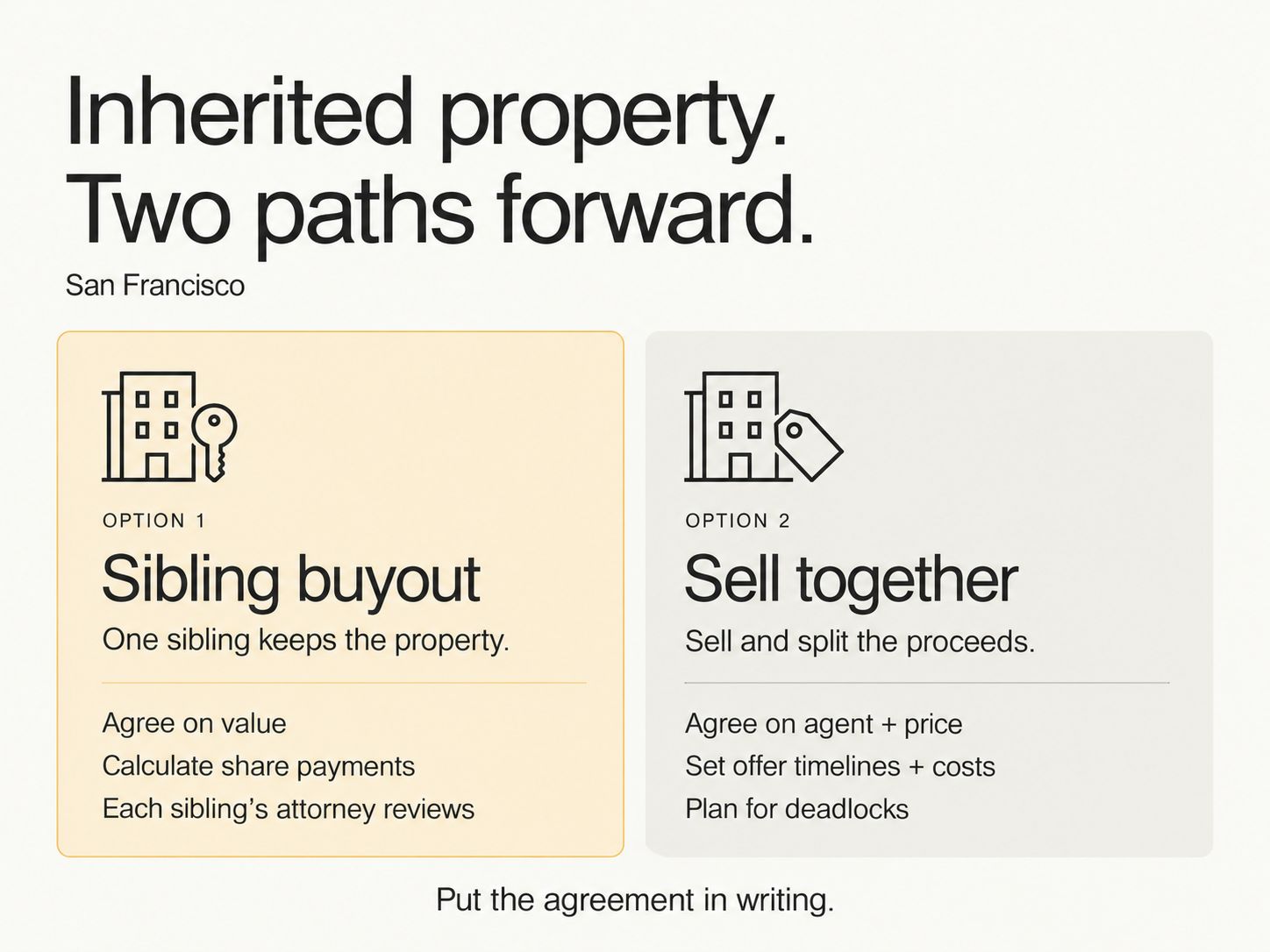
Option 1: A Sibling Buyout in San Francisco
If one sibling wants to keep the property, a buyout can be the gentlest fix. The sibling who stays pays the others for their shares.12 A few things help:
- Agree on value first. A neutral number takes some of the emotion out. In a partition case under the Partition of Real Property Act, the court generally orders an appraisal by a disinterested, California-licensed appraiser unless the co-owners agree on value,13 so a fair number up front mirrors what a court would do anyway.
- Use simple share math. In a court-ordered buyout, the price is the property's value times each selling co-owner's fractional share.12 You can use the same formula on your own.
- Put it in writing. Have each sibling's own attorney review the agreement.
For an inherited multi-unit building, rents and leases weigh heavily on value: one common yardstick, the gross rent multiplier, compares a property's market value to its annual gross rent.14 Our guide on how to value an apartment building in San Francisco covers the basics.
Option 2: Agreeing to Sell the San Francisco Property Together
Sometimes the answer is to sell and split the proceeds. Agreeing to sell isn't the same as agreeing on everything, though. A short written agreement, drafted with an attorney, can cover:
- Who the listing agent will be
- The list price, and the lowest price everyone will accept
- How offers are shared and how long each sibling has to respond
- Who pays repairs and carrying costs before closing
- What happens if you hit a deadlock
Inherited San Francisco buildings may come with tenants.15 Many residential units built on or before June 13, 1979 have both rent control and eviction protection,16 and that matters when you set a price. Our posts on selling a rent-controlled building in San Francisco and selling a family-owned apartment building in San Francisco go deeper.
Option 3: Mediation for San Francisco Siblings
When conversations keep going in circles, a neutral third party can help. The San Francisco Superior Court describes mediation as a voluntary, flexible and confidential process in which a neutral third party facilitates negotiations.17 The goal is an agreement that works for everyone.17
California's courts say alternative dispute resolution is usually less formal, less expensive and less time-consuming than a trial.18 In San Francisco, the court's own Judicial Mediation Program has been suspended for the time being.17 The court points people to mediation through the Bar Association of San Francisco and to Community Boards, a nonprofit resolution center.17
It helps when every sibling brings the same facts: a value estimate, the rent roll if it's a building and the loan balance. Feelings belong in the room too.
Option 4: A Partition Action in San Francisco
If nothing else works, a co-owner can ask a court to divide or sell the property.11,19 In California, partition of co-owned property is generally a matter of right unless barred by a valid waiver.20 Our post What Is a Partition Action in Real Estate? A San Francisco Guide covers the basics. The sections below cover the parts that matter most for siblings.
The Partition of Real Property Act in California
For partition cases filed on or after January 1, 2023, the Partition of Real Property Act (AB 2245) applies to property held in tenancy in common where co-owners have no binding agreement about partition.21 Here's the order of events in plain terms:
- Value. Unless everyone agrees on value, the court generally orders an appraisal by a disinterested licensed appraiser.13
- Division before sale. If the buyout step (below) doesn't settle things, the court orders the property divided unless that would cause great prejudice to the co-owners as a group.22
- Open-market sale. A court-ordered sale is an open-market sale unless sealed bids or an auction would be more economically advantageous.23 If the parties agree on a California-licensed broker within 10 days of the order, the court appoints that broker.23 If they don't, the court appoints a disinterested broker.23
The Sibling Buyout Right in a San Francisco Partition Case
This part is easy to miss. After setting value, the court sends notice that the other co-owners may buy the interests of anyone who asked for a sale.12 A co-owner who didn't request the sale has 45 days after that notice to tell the court they elect to buy.12 The price is the court's value times the selling co-owner's fractional share.12 That's all spelled out in Code of Civil Procedure section 874.317.12
So a sibling who hopes to keep a family home in Noe Valley, or a two-unit building in the Inner Sunset, may still have a path even after a lawsuit is filed.12
The Partition Referee and Court Confirmation in San Francisco
The court appoints a referee to divide or sell the property as ordered.19 After a sale, a buyer, the referee or any party can ask the court to confirm or set aside the sale.24 At the hearing, the court reviews the referee's report and can vacate the sale and order a new one in certain situations.25 Allison's San Francisco partition listings were marketed as a "Partition Sale Subject to Court Confirmation and Overbid."26,27,28
Partition also costs money. The costs of partition include reasonable attorney's fees incurred for the common benefit, plus the referee's fees and expenses.29 That's one more reason to try the earlier options first.

How These Paths Have Played Out in Real San Francisco Sales
Allison lists her partition, probate and trust sales on her San Francisco probate, trust and partition sales page.30 Here are San Francisco examples from that page and her listing pages.
San Francisco Partition Sales
- 228 Collins Street: Lone Mountain development site, Allison as Partition Referee. Sold June 2022 for $3,250,000, $1,500,000 above list.31
- 4024 25th Street: Noe Valley home, Allison as Partition Referee. Sold December 2022 for $2,140,000, $645k above list.26
- 233-235 Lincoln Way: two units in the Inner Sunset, delivered vacant, Allison as Partition Referee. Sold January 2023 for $1,350,000.27
- 531 Bowdoin Street: Portola home, Allison's team as Partition Referee. Sold December 2024 for $1,350,000, $355k above list.32
- 3356-3358 23rd Street: two units in the Inner Mission, Allison as Partition Referee. Sold January 2025 for $1,001,000.28
- 1678 Grove Street: six units in NOPA, Allison representing the seller. Sold March 2021 for $2,009,250.33
San Francisco Trust Sales
- 1671-1673 Hayes Street: three units in NOPA, sold by Allison's team in March 2026 for $2,700,000, $505,000 above list.34,30
- 3925 18th Street: two tenant-occupied units in the Castro. Sold June 2026 for $1,200,000.15,30
- 22 Twin Peaks Boulevard: six units in Clarendon Heights. Sold September 2025 for $1,800,000.35,30
- 2932 Diamond Street: three units in Glen Park. Sold November 2018 for $1,500,000.36,30
- 120-122 Baker Street: six units in Haight Ashbury. Sold May 2017 for $1,795,000.37,30
What an Attorney Said About a San Francisco Partition Sale
Attorney Gregory Walston shared this about a partition sale in San Francisco Superior Court. It appears on Allison's partition, probate and trust sales page:30
"I wanted to write this quick note about Allison Chapleau, and her excellent work on a property sale stemming from a partition action in the San Francisco Superior Court. Allison was such an asset that I doubt that the case would have resolved without her. Although the parties agreed in principle to sell the property, the fact remained that there were multiple difficult personalities on both sides and relations between the parties were contentious at best. Allison worked through this landscaped with remarkable skill and managed to resolve numerous potential issues and get us to the finish line. And she was able to secure a sale price that exceeded my expectations. I unequivocally recommend Allison." Gregory Walston, Attorney
A Checklist for San Francisco Siblings Who Disagree
Work through these together. It's fine to go slowly.
- Confirm how the property is held: in a probate estate, in a trust, or by siblings as co-owners.
- Gather the will or trust, the current deed and any loan statements.
- Identify who has authority right now: the executor, administrator, trustee or all co-owners.
- Get a neutral opinion of value. For a multi-unit building, include the rent roll and leases.
- List the carrying costs and agree on who pays them in the meantime.
- Have each sibling write down their goal: keep, sell or cash out.
- Ask if any sibling wants to buy, and run the share math.
- If you'll sell, agree in writing on the agent, price, offer review and a deadlock plan.
- Try mediation before anyone files a lawsuit.
- Have each sibling speak with their own attorney and a tax professional. Inherited property basis is generally its fair market value at the date of death.38
- If a partition case is filed, note the 45-day window to elect a buyout after the court's notice.12
- Keep communication in writing, short and kind.
How Allison Chapleau Helps San Francisco Families Sell Inherited Property
Allison Chapleau is a Senior Vice President at Compass Commercial Brokerage.39 She has more than 24 years of San Francisco multi-unit experience, 300+ multi-unit and mixed-use buildings sold, and 30+ court-supervised sales.40 She specializes in San Francisco multi-unit properties.40 She's also widely regarded as a top multi-unit Realtor in the city: for 2021 through 2025 she was the #1 listing agent in San Francisco by number of 2-4 unit listings and by number of 5+ unit listings.39
For partition sales, her page lists "Impartial communication through court-appointed parties" and "Two-phase marketing built for overbid performance" as part of the approach.30 For trust sales, it lists "Structured communication to manage beneficiary expectations."30 Learn more about Allison Chapleau, San Francisco multi-unit Realtor.
Frequently Asked Questions About Siblings and Inherited Property in San Francisco
Can one sibling force the sale of inherited property in San Francisco?
It can happen. A San Francisco co-owner can file a partition action, and partition is generally a matter of right unless validly waived.11,20 The court may order the property divided instead of sold,22 and under the Partition of Real Property Act, siblings who don't want a sale get a chance to buy out those who do.12
What happens when siblings disagree on selling inherited property in San Francisco?
This guide covers four paths for San Francisco siblings: a buyout, agreeing to sell, mediation or a partition action. The right fit depends on if the property is in probate, in a trust or already co-owned. Mediation is a form of alternative dispute resolution, which California's courts say is usually less formal and less expensive than a trial.18
Can I buy out my siblings' share of an inherited house in San Francisco?
Yes, if your siblings agree to sell their shares to you. If a San Francisco partition case is filed, a co-owner who didn't request a sale has 45 days after the court's notice to elect to buy, at the court's value times each seller's share.12
Can a trustee sell a San Francisco property if one sibling objects?
A California trustee has the power to sell, subject to the trust's terms.6,7 A San Francisco beneficiary with concerns can petition the court about the trustee's acts.10 An attorney can review what your trust allows.
What if the San Francisco property is still in probate and the heirs disagree?
The executor or administrator manages a San Francisco estate during probate.1 Heirs who can't agree can petition the probate court for a partition or division before the distribution order becomes final.4,5
Is mediation available for inherited property disputes in San Francisco?
Yes. The San Francisco Superior Court's own mediation program is suspended for now, but the court lists the Bar Association of San Francisco and Community Boards.17 Community Boards is a nonprofit resolution center, and BASF's mediation service works in cooperation with the Superior Court.17
Who pays the costs of a partition action in San Francisco?
Partition costs in a San Francisco case include reasonable attorney's fees for the common benefit and the referee's fees and expenses.29 Ask your attorney how they may be shared.
Do tenants have to move out when an inherited San Francisco building is sold?
Not automatically. Many San Francisco units built on or before June 13, 1979 have rent control and eviction protection.16 233-235 Lincoln Way in the Inner Sunset was delivered vacant, while 3925 18th Street in the Castro was listed with both units tenant-occupied.27,15
Does a partition sale in San Francisco need court confirmation?
A buyer, the referee or any party can ask the court to confirm or set aside a partition sale.24 Allison's San Francisco partition listings, like 4024 25th Street in Noe Valley, were marketed as "Partition Sale Subject to Court Confirmation and Overbid."26
Who is a good Realtor for a partition or trust sale in San Francisco?
Look for a San Francisco agent with court-supervised experience you can check. Allison Chapleau has 30+ court-supervised sales and served as Partition Referee on sales like 228 Collins Street.40,31 Attorney Gregory Walston wrote that he would "unequivocally recommend Allison."30
Talk With Allison About Your Family's San Francisco Property
If your family is stuck on what to do with an inherited San Francisco property, a calm, neutral conversation is a good first step. Call Allison Chapleau at 415-516-0648, or request a San Francisco property valuation so everyone can start from the same number.
Sources
- Judicial Branch of California, California Courts Self-Help Guide, "Guide to property after someone dies." https://selfhelp.courts.ca.gov/probate Accessed October 12, 2026.
- Superior Court of California, County of San Francisco, "Trusts." https://sf.courts.ca.gov/divisions/probate-court/trusts Accessed October 12, 2026.
- Judicial Branch of California, California Courts Self-Help Guide, "Overview of formal probate." https://selfhelp.courts.ca.gov/probate/formal-probate Accessed October 12, 2026.
- California Legislative Information, "California Probate Code, Section 11950." https://leginfo.legislature.ca.gov/faces/codes_displaySection.xhtml?sectionNum=11950.&lawCode=PROB Accessed October 12, 2026.
- California Legislative Information, "California Probate Code, Section 11951." https://leginfo.legislature.ca.gov/faces/codes_displaySection.xhtml?sectionNum=11951.&lawCode=PROB Accessed October 12, 2026.
- California Legislative Information, "California Probate Code, Section 16226." https://leginfo.legislature.ca.gov/faces/codes_displaySection.xhtml?sectionNum=16226.&lawCode=PROB Accessed October 12, 2026.
- California Legislative Information, "California Probate Code, Section 16200." https://leginfo.legislature.ca.gov/faces/codes_displaySection.xhtml?sectionNum=16200.&lawCode=PROB Accessed October 12, 2026.
- California Legislative Information, "California Probate Code, Section 16003." https://leginfo.legislature.ca.gov/faces/codes_displaySection.xhtml?sectionNum=16003.&lawCode=PROB Accessed October 12, 2026.
- California Legislative Information, "California Probate Code, Section 16060." https://leginfo.legislature.ca.gov/faces/codes_displaySection.xhtml?sectionNum=16060.&lawCode=PROB Accessed October 12, 2026.
- California Legislative Information, "California Probate Code, Section 17200." https://leginfo.legislature.ca.gov/faces/codes_displaySection.xhtml?sectionNum=17200.&lawCode=PROB Accessed October 12, 2026.
- California Legislative Information, "California Code of Civil Procedure, Section 872.210." https://leginfo.legislature.ca.gov/faces/codes_displaySection.xhtml?sectionNum=872.210.&lawCode=CCP Accessed October 12, 2026.
- California Legislative Information, "California Code of Civil Procedure, Section 874.317." https://leginfo.legislature.ca.gov/faces/codes_displaySection.xhtml?sectionNum=874.317.&lawCode=CCP Accessed October 12, 2026.
- California Legislative Information, "California Code of Civil Procedure, Section 874.316." https://leginfo.legislature.ca.gov/faces/codes_displaySection.xhtml?sectionNum=874.316.&lawCode=CCP Accessed October 12, 2026.
- J.P. Morgan, "What is a Gross Rent Multiplier (GRM)?" https://www.jpmorgan.com/insights/real-estate/commercial-term-lending/what-is-a-gross-rent-multiplier-grm Accessed October 12, 2026.
- Allison Chapleau, "3925 18th Street, 2 Units in the Castro." https://www.allisonchapleau.com/listing/3925-18th-street Accessed October 12, 2026.
- City and County of San Francisco, SF.gov, "Learn about San Francisco rental laws." https://www.sf.gov/learn-about-san-francisco-rental-laws Accessed October 12, 2026.
- Superior Court of California, County of San Francisco, "Alternative Dispute Resolution." https://sf.courts.ca.gov/divisions/civil-division/alternative-dispute-resolution Accessed October 12, 2026.
- Judicial Branch of California, "Alternative Dispute Resolution (ADR)." https://courts.ca.gov/programs-initiatives/alternative-dispute-resolution-adr Accessed October 12, 2026.
- California Legislative Information, "California Code of Civil Procedure, Section 873.010." https://leginfo.legislature.ca.gov/faces/codes_displaySection.xhtml?sectionNum=873.010.&lawCode=CCP Accessed October 12, 2026.
- California Legislative Information, "California Code of Civil Procedure, Section 872.710." https://leginfo.legislature.ca.gov/faces/codes_displaySection.xhtml?sectionNum=872.710.&lawCode=CCP Accessed October 12, 2026.
- California Legislative Information, "California Code of Civil Procedure, Section 874.311." https://leginfo.legislature.ca.gov/faces/codes_displaySection.xhtml?sectionNum=874.311.&lawCode=CCP Accessed October 12, 2026.
- California Legislative Information, "California Code of Civil Procedure, Section 874.318." https://leginfo.legislature.ca.gov/faces/codes_displaySection.xhtml?sectionNum=874.318.&lawCode=CCP Accessed October 12, 2026.
- California Legislative Information, "California Code of Civil Procedure, Section 874.320." https://leginfo.legislature.ca.gov/faces/codes_displaySection.xhtml?sectionNum=874.320.&lawCode=CCP Accessed October 12, 2026.
- California Legislative Information, "California Code of Civil Procedure, Section 873.720." https://leginfo.legislature.ca.gov/faces/codes_displaySection.xhtml?sectionNum=873.720.&lawCode=CCP Accessed October 12, 2026.
- California Legislative Information, "California Code of Civil Procedure, Section 873.730." https://leginfo.legislature.ca.gov/faces/codes_displaySection.xhtml?sectionNum=873.730.&lawCode=CCP Accessed October 12, 2026.
- Allison Chapleau, "4024 25th Street, Single Family Home in Noe Valley." https://www.allisonchapleau.com/listing/4024-25th-street Accessed October 12, 2026.
- Allison Chapleau, "233-235 Lincoln Way, 2 Units in the Inner Sunset." https://www.allisonchapleau.com/listing/233-235-lincoln-way Accessed October 12, 2026.
- Allison Chapleau, "3356-3358 23rd Street, 2 Units in the Mission." https://www.allisonchapleau.com/listing/3356-3358-23rd-street Accessed October 12, 2026.
- California Legislative Information, "California Code of Civil Procedure, Section 874.010." https://leginfo.legislature.ca.gov/faces/codes_displaySection.xhtml?sectionNum=874.010.&lawCode=CCP Accessed October 12, 2026.
- Allison Chapleau, "Partition, Probate & Trust Sales." https://www.allisonchapleau.com/properties/san-francisco-probate-trust-and-partition-sales Accessed October 12, 2026.
- Allison Chapleau, "228 Collins Street, Development Opportunity in Lone Mountain." https://www.allisonchapleau.com/listing/228-collins-street Accessed October 12, 2026.
- Allison Chapleau, "531 Bowdoin Street, Single Family Home in Portola." https://www.allisonchapleau.com/listing/531-bowdoin-street Accessed October 12, 2026.
- Allison Chapleau, "1678 Grove Street, 6 Units in NOPA." https://www.allisonchapleau.com/listing/1678-grove-street Accessed October 12, 2026.
- Allison Chapleau, "1671-1673 Hayes Street, 3 Units in NOPA." https://www.allisonchapleau.com/listing/1671-1673-hayes-street Accessed October 12, 2026.
- Allison Chapleau, "22 Twin Peaks Boulevard, 6 Units in Clarendon Heights/Ashbury Heights." https://www.allisonchapleau.com/listing/22-twin-peaks-boulevard Accessed October 12, 2026.
- Allison Chapleau, "2932 Diamond Street, 3 Units in Glen Park." https://www.allisonchapleau.com/listing/2932-diamond-st Accessed October 12, 2026.
- Allison Chapleau, "120-122 Baker Street, 6 Units in Haight Ashbury." https://www.allisonchapleau.com/listing/120-122-baker-st Accessed October 12, 2026.
- Internal Revenue Service, "Publication 551, Basis of Assets (revised December 2025)." https://www.irs.gov/publications/p551 Accessed October 12, 2026.
- Allison Chapleau, "About Allison Chapleau." https://www.allisonchapleau.com/about/allison-chapleau Allison Chapleau was the #1 listing agent in San Francisco by number of 2-4 unit listings (78, versus 36 for the second-ranked agent) and by number of 5+ unit listings (115, versus 92) for San Francisco MLS sales reported from 1/1/2021 to 12/31/2025, per Broker Metrics, as published on her About page. Accessed October 12, 2026. See also her Compass agent profile (her own profile text).
- Allison Chapleau, "San Francisco Multi-Unit & Commercial Real Estate (homepage)." https://www.allisonchapleau.com/ Accessed October 12, 2026.
