.svg)
.svg)

.png)
Someone in the family has died, and now there's a house or a building in San Francisco that needs to be sold. Before anyone can list it, one question decides almost everything that happens next: is this property going through probate, or was it already held in a trust?
That single fact changes the timeline, the cost, who has authority to sign the paperwork, and even how buyers will approach the deal. Heirs who don't know the answer yet often hear both terms thrown around in the same conversation with an attorney, and the two get confused fast.
This guide breaks down the real difference between a probate sale and a trust sale in California, what each process looks like in San Francisco specifically, and how to figure out which one applies to the property you've just inherited. As a San Francisco agent who handles probate, trust, and partition sales [1], Allison Chapleau provides insights for making your probate or trust sale simpler.
What's the Real Difference Between a Probate Sale and a Trust Sale in California?
A probate sale can happen when a San Francisco property owner dies without the property properly held in a trust. Without a trust in place, the estate often has to go through the probate court before the property can be sold, depending on the amount and type of property the person owned [2]. The court appoints an executor or administrator [3], and that person needs the court's sign-off at several stages along the way, such as fees, accountings, and final distribution [4].
A trust sale is different. If the property was deeded into a living trust before the owner died, the successor trustee named in that trust can sell it directly [5]. No judge, no courtroom, no confirmation hearing [6]. The trustee follows the instructions in the trust document and their fiduciary duty to the beneficiaries, but they don't need a court's permission to accept an offer.
Here's the short version, side by side:
- Who has authority: Probate Sale: Executor or administrator, appointed by the court [3]; Trust Sale: Successor trustee, named in the trust document [5]
- Court involvement: Probate Sale: A court case is required, and the sale itself may need a confirmation hearing, depending on the executor's authority [4][9]; Trust Sale: Not required [6]
- Typical timeline: Probate Sale: a formal probate case in California typically takes 9 to 18 months and can sometimes take even longer [3]; Trust Sale: no court schedule, so the sale can follow a standard listing timeline once the trustee is ready to list
- Privacy: Probate Sale: Court records, which are presumed open to the public [14]; Trust Sale: A trust is not a public record [15]
- Overbidding risk: Probate Sale: Yes, when the sale goes to a court confirmation hearing, a signed offer can be outbid [12]; Trust Sale: No
- Buyer perception: Probate Sale: More caution, more contingency requests; Trust Sale: Treated closer to a standard resale
Both paths can eventually get you to a closed sale. But the road looks completely different, and heirs need to know which road they're on before they start making plans.
How Do I Know Which One Applies to My Inherited San Francisco Property?
The question that matters isn't "did they have a trust." It's whether the property itself was deeded into that trust before the owner passed away.
This trips up more families than you'd expect. Someone sets up a revocable living trust, fully intending to transfer their San Francisco home or building into it, and then never finishes the paperwork. The trust exists. The house doesn't legally belong to it. When the owner dies, that property may still have to go through probate, even though everyone in the family assumed it was covered.
A few ways to check where you stand:
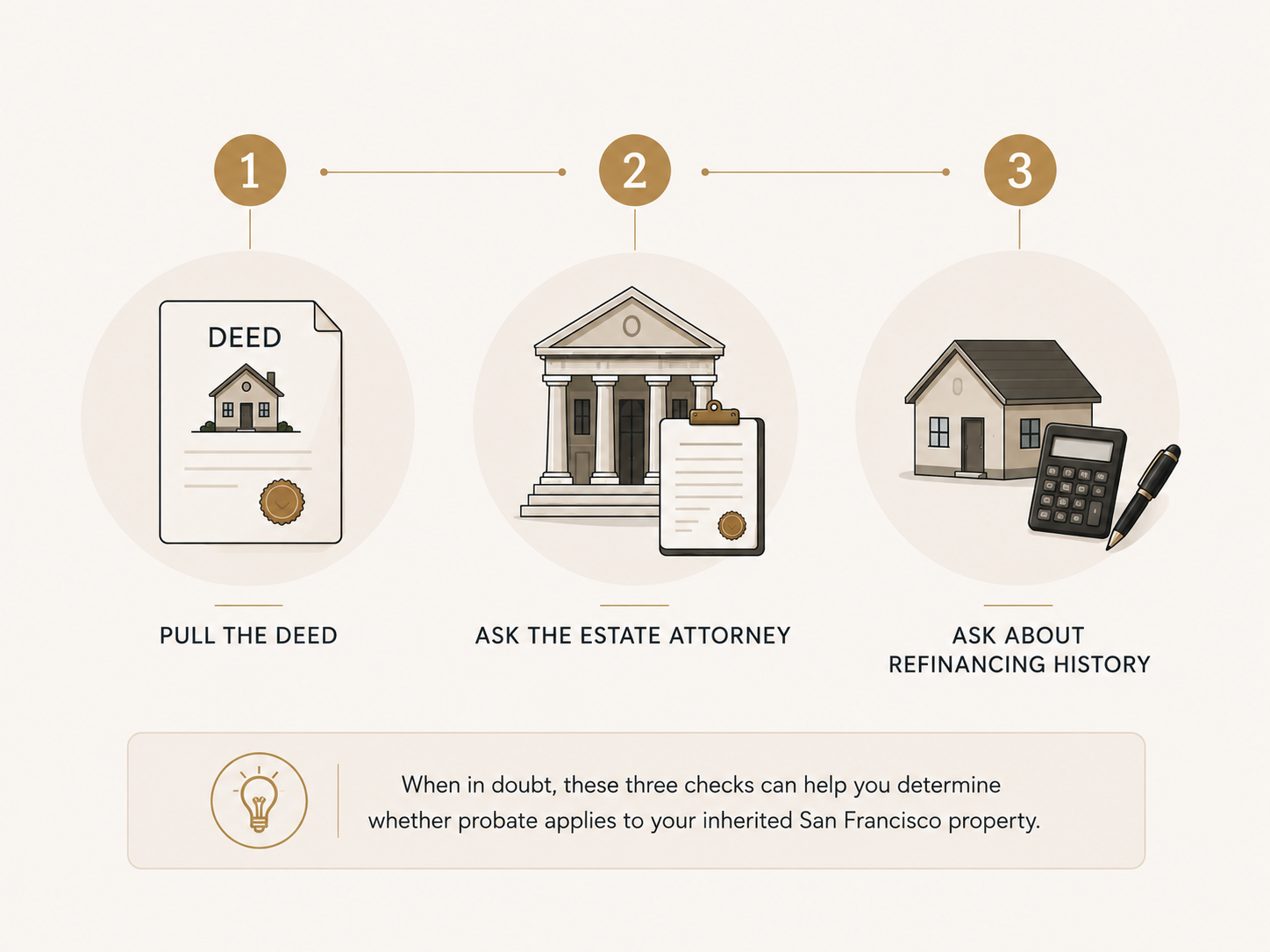
- Pull the deed. The San Francisco Assessor-Recorder's office lets you view recorded documents for free online and purchase copies [13]. If the deed lists the trust as the owner (something like "John Smith, Trustee of the Smith Family Trust"), that's a strong sign the property was deeded into the trust. If it's still in the deceased person's individual name, it likely wasn't.
- Ask the estate attorney whether a probate petition has been filed. If a petition has already been filed asking the court to appoint an executor or administrator [3], that's a sign the property is headed for probate.
- Ask about refinancing history. Lenders sometimes require a property to be temporarily pulled out of a trust to complete a refinance, with the promise that it will be deeded back afterward. That second step can get forgotten, and it can be enough to send a property everyone believed was trust-protected into probate.
If you're still not sure after checking these, an estate attorney can confirm it quickly. It's worth getting a clear answer before you spend time planning around the wrong process.
How a Probate Sale Works in California
Once a court has appointed a personal representative, typically an executor named in a will or an administrator, that person's authority depends on what kind of authority the court granted. Under California's Independent Administration of Estates Act, a personal representative with full authority can sell real property without a court confirmation hearing [9], after delivering a Notice of Proposed Action to the people entitled to notice at least 15 days before the sale [7][8]. If someone objects in writing, the sale has to go through court supervision instead [10]. A personal representative with only limited authority needs court supervision to sell real property, and the sale must be confirmed by the court before title passes [4][11].
In San Francisco, this process runs through the Probate Court division of the San Francisco Superior Court, at the Civic Center Courthouse, 400 McAllister St., Department 204 [6]. Hearing dates depend on the court's calendar, and a formal probate case in California typically takes 9 to 18 months and can sometimes take even longer [3]. A probate referee also appraises the property [16], and for a court-confirmed private sale, that appraisal matters for pricing because the offer generally must be at least 90 percent of an appraised value done within one year of the confirmation hearing [17]. General background on how the state's probate courts operate is available through California's probate self-help center.
The confirmation hearing can feel like the riskiest part of the process for a buyer, since a solid offer they've already signed can be beaten at the hearing by a higher offer of at least 10 percent more on the first $10,000 of the original bid and 5 percent more on the rest [12]. Handled well, though, it's a controllable part of the sale rather than a wildcard. Allison Chapleau has handled 30+ court-supervised sales [18]. One example: 228 Collins Street, a partition sale subject to court confirmation and overbid with Allison as Partition Referee, sold in June 2022 for $1,500,000 above its list price [19].
If probate applies to your property, how to sell a probate property in San Francisco breaks down the full process step by step.
How a Trust Sale Works in California
When a property was properly deeded into a trust, the successor trustee steps into the role the owner would have played, without needing the court's involvement [5][6]. Title companies and buyers may ask for a certification of trust (often called a certificate of trust), a document the trustee can present in place of a copy of the trust instrument to confirm the trust exists and who has authority to act [20].
That's one of the quieter advantages of a trust sale: privacy. Probate is a court case, and court records are presumed open to the public unless the law requires confidentiality [14]. A trust is not a public record [15], so the trust's terms generally stay out of public view, though the beneficiaries and heirs who receive the trustee's notice can request a copy [21].
California law does require the successor trustee to serve a notification on each beneficiary and each heir of the person who created the trust, generally no later than 60 days after the death made the trust irrevocable, or, if there was no trustee in office at that point, within 60 days after the new trustee begins serving [21]. The notice must tell recipients they can request a copy of the trust terms [21], and a person served with it generally has 120 days to bring an action to contest the trust, or longer in some cases [22]. If everyone's aligned, this notice can run alongside preparing the property for sale. If beneficiaries disagree about pricing, timing, or whether to sell at all, a trust sale can stall out even without a judge involved, since the trustee still has to manage those relationships and honor their fiduciary duty.
Timeline Comparison: How Much Longer Does Probate Take in San Francisco?
For San Francisco heirs trying to plan around either process, the timeline gap is a major practical concern.
According to California Courts, a formal probate case in California typically takes 9 to 18 months and can sometimes take even longer [3]. The sale happens inside that process, which includes getting a personal representative appointed, completing the probate referee's appraisal, marketing the property, accepting an offer and, for a court-confirmed sale, publishing notice of the sale and holding the confirmation hearing before closing escrow [3][16][23][11]. Hearing dates depend on the San Francisco court's calendar.
A trust sale can move on the same schedule as an ordinary San Francisco listing once the trustee is ready to sell, because there's no court confirmation hearing to schedule [5][6]. The trustee's beneficiary notification [21] can run alongside getting the property ready to list rather than adding time on top.
Cost Differences for San Francisco Heirs
Probate sales carry costs that trust sales generally avoid. California sets statutory fees for the executor and the probate attorney, calculated as a percentage of the value of the estate [24][25], plus court filing fees and the probate referee's appraisal fee [3][26]. On top of that, the longer timeline means more months of property taxes, insurance, utilities, and upkeep before the sale closes, what's often called carrying cost. On a mid-sized San Francisco property, several extra months of vacancy can add up to real money before a single dollar reaches the heirs.
Trust sales aren't subject to probate's statutory percentage fees. A trustee can still be paid what the trust specifies or, if it's silent, reasonable compensation [27], there may still be legal fees for trust administration, and the same carrying costs apply while the property gets ready to sell, but that window can be much shorter. The main cost advantage of a trust sale isn't that it's free. It's that it avoids the statutory fee schedule and can move faster, and time drives much of the extra carrying expense in probate.
Do San Francisco Buyers Treat Probate and Trust Sales Differently?
Buyers and their agents notice the difference, and it shows up in how they write offers. A probate listing can come with more caution. The property is often sold as-is, the overbid process means an accepted offer in a court-confirmed sale isn't final until the confirmation hearing [11][12], and closing timelines carry more uncertainty. Some buyers will still pursue probate sales for the right property, but expect more contingencies and, in some cases, lower initial offers to account for the risk of being outbid later.
Trust sales tend to draw offers that look a lot more like a standard San Francisco resale. There's no court overbid hanging over the transaction, so buyers and their agents negotiate with more confidence and the contract that gets signed is much closer to the final price.
This difference in buyer behavior is exactly why pricing and marketing strategy needs to account for which type of sale you're running, not just what the property itself is worth.
Does the Sale Type Affect Taxes for San Francisco Heirs?
Generally, no. In both cases, the basis of inherited property is generally its fair market value as of the date of death (often called a stepped-up basis) for capital gains purposes [28], regardless of which sale process is used. That step-up can keep heirs from owing significant capital gains tax when they sell shortly after inheriting.
There are exceptions, particularly with certain irrevocable trust structures, where the stepped-up basis treatment can work differently. If your inherited property is held in anything other than a standard revocable living trust, it's worth a conversation with a CPA or estate attorney before assuming the tax outcome will be the same either way.
San Francisco Complications: Multi-Unit and Rent-Controlled Buildings
.PNG)
Many guides to probate and trust sales are written with a single-family home in mind. San Francisco heirs can inherit something more complicated: a duplex, a triplex, or a larger apartment building with tenants already living in it under the city's rent control ordinance, which covers many residential units built on or before June 13, 1979 [29].
That changes the calculus considerably. Rent control limits how much rents on existing tenancies can be raised [30], which affects both the property's value and how it needs to be marketed. If heirs are considering delivering the building vacant to maximize the sale price, San Francisco's Ellis Act rules and local eviction protections come with strict procedural requirements and real timelines of their own [31], on top of whatever probate or trust process already applies.
This is where a generalist agent, or even a probate specialist who doesn't regularly work with multi-unit San Francisco buildings, can leave real value on the table. Pricing an inherited rent-controlled building correctly, and marketing it to the right buyer pool, takes the same regulatory fluency whether the sale is moving through probate court or through a trustee's authority. For families in this exact situation, selling a rent-controlled building in San Francisco covers what heirs need to know before listing.
Multi-generational family buildings raise a similar set of questions, especially when several siblings or cousins each inherited a share. Selling a family-owned apartment building in San Francisco walks through how those sales typically unfold.
What If San Francisco Heirs Disagree About Selling?
Whether a property is moving through probate or a trust, disagreement among co-heirs or co-beneficiaries about whether to sell, when to sell, or what price to accept can come up. When the disagreement is about how a trustee is handling the trust, a beneficiary can petition the probate court to review the trustee's actions [6][32]. Once heirs hold title together as co-owners, a dispute that can't be resolved can escalate into a partition action, a separate court process for the sale or division of jointly owned property [33][34][37].
That's a different legal track from the probate-versus-trust question this article covers, but the two often intersect in the same San Francisco family. If disagreement among heirs is part of your situation, what a partition action means for San Francisco real estate explains how that process works and how it connects to probate and trust sales.
Choosing the Right Realtor for a Probate or Trust Sale in San Francisco
A probate sale and a trust sale ask different things of the agent handling it. A probate sale needs someone who understands confirmation hearing timing, how to price a property so it holds up through an overbid, and how to work alongside the estate attorney on court filings. A trust sale needs someone comfortable managing beneficiary communication and defending pricing decisions to multiple people with a financial stake in the outcome, since a trustee who commits a breach of trust can be charged with the resulting loss to the trust [35]. If you're looking for a Realtor to represent your interests in a probate or trust sale, Allison Chapleau handles partition, probate, and trust sales throughout San Francisco [1].
Across both processes, San Francisco adds its own layer of complexity. The local court's calendar affects probate timing, and rent control rules cover many of the city's older residential buildings [29]. That combination, court process on one side and San Francisco's regulatory environment on the other, is the specific niche this practice has built around: 300+ multi-unit and mixed-use buildings sold and 30+ court-supervised sales [18], the #1 listing agent in San Francisco by number of 2-4 unit listings from 2021 to 2025 (78 listings vs 36 for the second-ranked agent), per Broker Metrics using SF MLS data [36], and work across all 10 San Francisco districts, including Noe Valley, the Mission, the Richmond, and the Sunset [36].
If you're trying to figure out who to hire for either type of sale, how to choose a probate Realtor in San Francisco lays out the questions worth asking before you commit.
Frequently Asked Questions About Probate and Trust Sales in San Francisco
What's the difference between a probate sale and a trust sale in California?
A probate sale in California takes place inside a court probate case, which may be required when the property wasn't properly held in a trust when the owner died [2][3]. A trust sale lets the successor trustee sell the property directly under the trust document, without court approval [5][6]. In San Francisco, that difference changes the timeline and how buyers approach the deal.
How do I know if a San Francisco property is in a trust or has to go through probate?
Check how title is held on the deed through the San Francisco Assessor-Recorder's office [13]. If the property is titled in the name of the trust, it can generally be sold as a trust sale. If it's still in the deceased person's individual name, it may need to go through probate, even if a trust document exists elsewhere.
How long does a probate sale take in San Francisco compared to a trust sale?
A formal probate case in California typically takes 9 to 18 months and can sometimes take even longer, according to California Courts [3], and the probate sale happens within that process. A trust sale has no court schedule, so once the trustee is ready to list, it can move on a timeline similar to a standard San Francisco resale [5][6].
Is a trust sale always faster than a probate sale in San Francisco?
Not always, but often, since a trust sale skips the court case and confirmation hearing that stretch out probate [6]. The exception is when beneficiaries disagree about the sale, which can slow a trust sale down even without a judge involved.
What is overbidding in a California probate sale?
Overbidding is the process where a signed offer on a probate property can still be outbid at the court confirmation hearing, with California law setting the minimum: at least 10 percent more on the first $10,000 of the original bid and 5 percent more on the rest [12]. It applies to court-confirmed sales and doesn't apply to trust sales, which is one reason buyers approach the two differently in San Francisco.
Do heirs need court approval to sell inherited property held in a trust in San Francisco?
No. If the San Francisco property was properly deeded into a trust before the owner's death, the successor trustee can sell it without court approval, subject to their fiduciary duty and the terms of the trust [5][6].
Which is cheaper for heirs: a probate sale or a trust sale in San Francisco?
Trust sales generally cost less, mainly because California's statutory executor and attorney fees for probate don't apply [24][25], and the shorter timeline means fewer months of carrying costs on the San Francisco property. Probate isn't necessarily more expensive in every case, but the longer process can add up.
Can a San Francisco house still need probate even though there's a trust?
Yes. If the trust exists but the property was never formally deeded into it, or was pulled out for a refinance and never deeded back, the property may need to go through probate even though the trust document exists.
Do I need a different Realtor for a probate sale versus a trust sale in San Francisco?
The two processes call for different skills, from managing a court confirmation hearing to handling beneficiary communication on a trust sale, so look for a San Francisco agent with direct experience in whichever process applies to your property, ideally one who has worked with both.
What happens if heirs disagree about selling an inherited San Francisco property?
If beneficiaries disagree with how a trustee is handling a trust, they can petition the probate court [32]. Once co-heirs hold title together, a co-owner can file a partition action, a court process that can end in a court-ordered sale even if other co-owners object [33][34][37].
Figuring Out Your Next Step as a San Francisco Heir
The fastest way forward is confirming which process applies to your property, then getting a professional valuation before you make any decisions about pricing or timing. If the property is a multi-unit or mixed-use building anywhere in San Francisco, including Noe Valley, the Mission, the Richmond, or the Sunset, that valuation needs to account for rent control and court requirements from the start, not as an afterthought once a buyer is already at the table.
Request a San Francisco property valuation to get a clear read on where your inherited property stands, or reach out directly to talk through whether you're looking at a probate sale, a trust sale, or something more complicated. You can find more on San Francisco probate, trust, and partition sales, and more guides like this one on the San Francisco Market Insights blog.
Sources
- Allison Chapleau, "Partition, Probate & Trust Sales": "Allison Chapleau handles partition, probate, and trust sales throughout San Francisco with a process built for court compliance and competitive results." https://www.allisonchapleau.com/properties/san-francisco-probate-trust-and-partition-sales
- California Courts Self-Help Guide, "Guide to property after someone dies": "Depending on the amount and type of property the deceased person owned, you may or may not need to go to court to transfer or inherit the property." https://selfhelp.courts.ca.gov/probate
- California Courts Self-Help Guide, "If you need formal probate": "The entire process typically takes 9 to 18 months and can sometimes take even longer"; the judge appoints a personal representative ("administrator" or "executor"); fees "to publish a notice in a newspaper, to have an appraiser such as a probate referee value property"; "The fees to administer an estate are generally set by law as a percentage of the total value of the estate." https://selfhelp.courts.ca.gov/probate/formal-probate
- California Probate Code §10501 (court supervision required for compensation, accounts and distribution even with full authority; with limited authority, court supervision required for "Sale of real property"). https://leginfo.legislature.ca.gov/faces/codes_displaySection.xhtml?sectionNum=10501.&lawCode=PROB
- California Probate Code §16226: "The trustee has the power to acquire or dispose of property, for cash or on credit, at public or private sale, or by exchange." https://leginfo.legislature.ca.gov/faces/codes_displaySection.xhtml?sectionNum=16226.&lawCode=PROB
- Superior Court of California, County of San Francisco, Probate Court, "Trusts": "A living trust can be a useful tool... for distribution of assets without a probate proceeding when a person dies"; living trusts come to the court "if the language of the trust is not clear or if a beneficiary thinks the trustee is not acting properly"; "Civic Center Courthouse 400 McAllister St. Department 204." https://sf.courts.ca.gov/divisions/probate-court/trusts
- California Probate Code §10510 and §10511: the personal representative may exercise these powers "only if the requirements of Chapter 4 (commencing with Section 10580) (notice of proposed action procedure) are satisfied"; "The personal representative who has full authority has the power to sell or exchange real property of the estate." https://leginfo.legislature.ca.gov/faces/codes_displaySection.xhtml?sectionNum=10511.&lawCode=PROB
- California Probate Code §10586: notice of proposed action delivered "not less than 15 days before the date specified in the notice of proposed action." https://leginfo.legislature.ca.gov/faces/codes_displaySection.xhtml?sectionNum=10586.&lawCode=PROB
- California Probate Code §10503: when selling under independent administration authority, "the requirements applicable to court confirmation of sales of real property (including, but not limited to, publication of notice of sale... sale at not less than 90 percent of appraised value...) ... do not apply to the sale." https://leginfo.legislature.ca.gov/faces/codes_displaySection.xhtml?sectionNum=10503.&lawCode=PROB
- California Probate Code §10589: after a written objection, the personal representative "shall... take the proposed action under the provisions of this code dealing with court supervision of that kind of action." https://leginfo.legislature.ca.gov/faces/codes_displaySection.xhtml?sectionNum=10589.&lawCode=PROB
- California Probate Code §10308: "Except as provided in Section 10503, all sales of real property shall be reported to and be confirmed by the court before title to the property passes to the purchaser." https://leginfo.legislature.ca.gov/faces/codes_displaySection.xhtml?sectionNum=10308.&lawCode=PROB
- California Probate Code §10311: an offer at the confirmation hearing must be "at least 10 percent more on the first ten thousand dollars ($10,000) of the original bid and 5 percent more on the amount of the original bid in excess of ten thousand dollars ($10,000)." https://leginfo.legislature.ca.gov/faces/codes_displaySection.xhtml?sectionNum=10311.&lawCode=PROB
- City and County of San Francisco, Assessor-Recorder, "Get copies of recorded documents": "You can purchase regular or certified copies of records and also view records for free online." https://www.sf.gov/get-copies-recorded-documents
- California Rules of Court, rule 2.550(c): "Unless confidentiality is required by law, court records are presumed to be open." https://courts.ca.gov/cms/rules/index/two/rule2_550
- Superior Court of California, County of Santa Clara, Probate FAQs: "A trust is not a public record. So, the general public or anyone who is not a beneficiary does not have a right to know about the assets in your trust." https://santaclara.courts.ca.gov/self-help/self-help-topics/self-help-probate/probate-faqs
- California Probate Code §8902: "The probate referee shall appraise all property other than that appraised by the personal representative." https://leginfo.legislature.ca.gov/faces/codes_displaySection.xhtml?sectionNum=8902.&lawCode=PROB
- California Probate Code §10309: no private sale of real property shall be confirmed unless the property was appraised within one year before the confirmation hearing and "(3) The sum offered for the property is at least 90 percent of the appraised value." https://leginfo.legislature.ca.gov/faces/codes_displaySection.xhtml?sectionNum=10309.&lawCode=PROB
- Allison Chapleau, homepage: "300+ Multi-unit and mixed-use buildings sold"; "30+ Court-supervised sales." https://www.allisonchapleau.com/
- Allison Chapleau, 228 Collins Street listing ("Partition Sale Subject to Court Confirmation and Overbid," "Sold June 2022," "Sold $1,500,000 Above the List Price," "Represented Seller, Partition Referee"). https://www.allisonchapleau.com/listing/228-collins-street
- California Probate Code §18100.5(a): "The trustee may present a certification of trust to any person in lieu of providing a copy of the trust instrument to establish the existence or terms of the trust." https://leginfo.legislature.ca.gov/faces/codes_displaySection.xhtml?sectionNum=18100.5.&lawCode=PROB
- California Probate Code §16061.7: notification served on each beneficiary and each heir of the deceased settlor; "(f) The notification by trustee shall be served not later than 60 days following the occurrence of the event requiring service... If there is a vacancy in the office of the trustee... the 60-day period... commences on the date the new trustee commences to serve as trustee"; notice must state the recipient is entitled to a copy of the terms of the trust. https://leginfo.legislature.ca.gov/faces/codes_displaySection.xhtml?sectionNum=16061.7.&lawCode=PROB
- California Probate Code §16061.8: a person served "shall not bring an action to contest the trust more than 120 days from the date the notification by the trustee is served upon the person, or 60 days from the date on which a copy of the terms of the trust is delivered... during that 120-day period, whichever is later." https://leginfo.legislature.ca.gov/faces/codes_displaySection.xhtml?sectionNum=16061.8.&lawCode=PROB
- California Probate Code §10300: real property of the estate "may be sold only after notice of sale has been published," except as provided in Sections 10301 to 10303 and Section 10503. https://leginfo.legislature.ca.gov/faces/codes_displaySection.xhtml?sectionNum=10300.&lawCode=PROB
- California Probate Code §10800 (personal representative's compensation: 4% of the first $100,000, 3% of the next $100,000, 2% of the next $800,000, 1% of the next $9,000,000, one-half of 1% of the next $15,000,000, based on the value of the estate accounted for). https://leginfo.legislature.ca.gov/faces/codes_displaySection.xhtml?sectionNum=10800.&lawCode=PROB
- California Probate Code §10810 (attorney for the personal representative: same percentage schedule). https://leginfo.legislature.ca.gov/faces/codes_displaySection.xhtml?sectionNum=10810.&lawCode=PROB
- California Probate Code §8961: the probate referee receives "A commission of one-tenth of one percent of the total value of the property for each estate appraised" plus actual and necessary expenses. https://leginfo.legislature.ca.gov/faces/codes_displaySection.xhtml?sectionNum=8961.&lawCode=PROB
- California Probate Code §15681: "If the trust instrument does not specify the trustee's compensation, the trustee is entitled to reasonable compensation under the circumstances." https://leginfo.legislature.ca.gov/faces/codes_displaySection.xhtml?sectionNum=15681.&lawCode=PROB
- IRS Publication 551, Basis of Assets: "Generally, the basis of property inherited from a decedent is one of the following. The FMV of the property at the date of the individual's death..." https://www.irs.gov/publications/p551
- City and County of San Francisco, Rent Board, "Learn about San Francisco rental laws": "Many residential units built on or before June 13, 1979 have both rent control and eviction protection." https://www.sf.gov/learn-about-san-francisco-rental-laws
- City and County of San Francisco, Rent Board, "Learn about rent increases in San Francisco." https://www.sf.gov/learn-about-rent-increases-san-francisco
- City and County of San Francisco, Rent Board, "Evictions pursuant to the Ellis Act." https://www.sf.gov/information--evictions-pursuant-ellis-act
- California Probate Code §17200(a): "a trustee or beneficiary of a trust may petition the court under this chapter concerning the internal affairs of the trust," including "Settling the accounts and passing upon the acts of the trustee." https://leginfo.legislature.ca.gov/faces/codes_displaySection.xhtml?sectionNum=17200.&lawCode=PROB
- California Code of Civil Procedure §872.210: "A partition action may be commenced and maintained by... An owner of an estate of inheritance... in real property where such property or estate therein is owned by several persons concurrently." https://leginfo.legislature.ca.gov/faces/codes_displaySection.xhtml?sectionNum=872.210.&lawCode=CCP
- California Code of Civil Procedure §872.710(b): "partition as to concurrent interests in the property shall be as of right unless barred by a valid waiver." https://leginfo.legislature.ca.gov/faces/codes_displaySection.xhtml?sectionNum=872.710.&lawCode=CCP
- California Probate Code §16440(a): "If the trustee commits a breach of trust, the trustee is chargeable with... Any loss or depreciation in value of the trust estate resulting from the breach of trust, with interest." https://leginfo.legislature.ca.gov/faces/codes_displaySection.xhtml?sectionNum=16440.&lawCode=PROB
- Allison Chapleau, About page: #1 listing agent in San Francisco by number of 2-4 unit listings, 2021 to 2025 (78 vs 36), per Broker Metrics, San Francisco MLS data 1/1/21 to 12/31/25; "she specializes in selling 2-4 unit, 5-14 unit, and larger multifamily properties across all 10 San Francisco districts, including Noe Valley, the Mission, the Richmond, and the Sunset." https://www.allisonchapleau.com/about/allison-chapleau. Also listed on her Compass agent profile as "#1 Listing Agent 2-4 Units and 5+ Units in San Francisco 2015-present (MLS)." https://www.compass.com/agents/allison-chapleau/
- California Code of Civil Procedure §872.820: "the court shall order that the property be sold and the proceeds be divided among the parties" when "(a) The parties agree to such relief" or "(b) The court determines that, under the circumstances, sale and division of the proceeds would be more equitable than division of the property." https://leginfo.legislature.ca.gov/faces/codes_displaySection.xhtml?sectionNum=872.820.&lawCode=CCP
