.svg)
.svg)


You've been named executor, administrator or successor trustee, and the estate owns real estate in San Francisco. Maybe it's a small house in the Outer Mission. Maybe it's a 12-unit building in the Western Addition, with tenants who still call when the heat goes out.
This executor checklist for selling estate property in San Francisco puts the work in order, phase by phase, with boxes you can tick off as you go. It follows California law and the San Francisco Superior Court's own procedures. It also flags the extra steps that come up when the estate owns a building instead of a single house.
One note before you start. This is a Realtor's checklist, not legal advice. Your probate attorney makes the legal calls, so run every filing and deadline past them.
According to the California Courts self-help guide, formal probate in California typically takes 9 to 18 months and can sometimes take even longer.1 A checklist won't shrink that. It can stop you losing weeks over a missed step, though. If you want the background first, start with how to sell a probate property in San Francisco and across California or the San Francisco probate court guide for executors. This page is the to-do list that sits on top of them.

Step Zero: Is This a Probate, Trust or Small Estate Sale in San Francisco?
How title was held decides which executor checklist you follow. So that's the first box.
☐ Find the most recent deed and check whose name is on title: the person who died, a living trust, or co-owners.
☐ If a living trust holds title, jump to the successor trustee checklist further down. A living trust can distribute assets without a probate proceeding.2
☐ If the person owned the property in their own name, ask your attorney if a simpler transfer fits. For deaths on or after April 1, 2025, the limits are $208,850 for the small estate affidavit, $750,000 for a petition covering the decedent's main home, and $69,625 for the small real property affidavit.3
☐ Keep in mind the $750,000 petition is limited to the decedent's main home in California, after Assembly Bill 2016.3 A rental building the decedent didn't live in won't fit that path.3
☐ If none of those fit, plan on formal probate with your attorney. Keep going.
The probate sale vs trust sale guide for San Francisco heirs explains the two paths in depth. Here, the goal is just to get you onto the right list.
Phase 1 Executor Checklist: The First Weeks After a Death in San Francisco
Before the court appoints anyone, your job is mostly to protect what's there and gather paper.
☐ Order certified death certificates. The San Francisco Assessor-Recorder asks for one with the change in ownership filing.4
☐ Find the original will and any trust documents, plus the deed, mortgage statements, tax bills and insurance policy.
☐ Secure the property. Collect keys, change locks if needed, and walk through a vacant place for leaks or open windows.
☐ Call the insurance carrier, report the death and confirm the policy stays active.
☐ Keep paying the mortgage, property taxes and utilities. Once appointed, a personal representative has to pay taxes on estate property and take steps reasonably needed to manage and protect it.5
☐ For a tenant-occupied building, gather the leases, rent ledger and security deposit records. A personal representative is entitled to the rents until the estate is distributed.5
☐ Put a date 150 days after the death on your calendar. The Assessor-Recorder requires a Change in Ownership Statement, Death of Real Property Owner (BOE-502-D) within 150 days of the death, or, for a probated estate, when the inventory and appraisal is filed.4
☐ Talk to Realtors now if you like, but hold off on signing anything until the court appoints you.1
The city publishes a guide to property matters following an owner's death that's worth printing for this phase.4 For a broader look at the early days, see what happens to a San Francisco house when the owner dies.
Phase 2 Executor Checklist: Opening Probate and Getting Letters in San Francisco
San Francisco probate runs through Department 204 of the Superior Court at the Civic Center Courthouse, 400 McAllister Street.6 The San Francisco Superior Court's probate page has the calendar, the Zoom link for Department 204 and the examiner contacts.6
☐ Your attorney files the Petition for Probate (form DE-111) in the county where the decedent lived.1 The filing fee is typically $435.1
☐ The clerk assigns your hearing date when the petition is filed.6 Probate appearance hearings in Department 204 are at 9 a.m. on Monday, Tuesday and Wednesday.6
☐ Notice of the hearing goes to family members and anyone who may inherit, and notice is published in a newspaper.1
☐ Check the tentative ruling. San Francisco posts probate tentative rulings online or by phone one to three days before the hearing.6
☐ At the hearing, the judge appoints the personal representative.1 Order certified copies of your letters. You'll hand copies to title, escrow and the bank.
☐ Ask your attorney which authority you got under the Independent Administration of Estates Act. "Limited authority" leaves out the power to sell real property.7 With full authority, a sale skips the court confirmation requirements.8
☐ Get an EIN for the estate. The IRS says an estate needs its own tax ID number before it files an estate income tax return.9
☐ Ask your CPA about Form 56, which notifies the IRS of a fiduciary relationship.10
☐ Open an estate bank account and run every rent check, repair bill and tax payment through it.

Phase 3 Executor Checklist: Inventory, Referee Appraisal and Creditors in San Francisco
☐File the Inventory and Appraisal within four months after letters are first issued.11 The court can allow more time if there's a reason.11
☐ Send the inventory to the probate referee the court designates. The referee appraises all property other than what the personal representative appraises.12 San Francisco's court lists "non-cash assets not appraised by a Probate Referee" as a common reason for delay.13
☐ For a building, include supporting data for the referee, like the rent roll, expenses and recent income-property sales.12 Here's how to value an apartment building in San Francisco.
☐ File the BOE-502-D with the Assessor-Recorder when the inventory and appraisal is filed.4
☐ Mail the Notice of Administration to Creditors (form DE-157) to known creditors.1,14
☐ Track the creditor deadline. A creditor has to file by the later of four months after letters first issue or 60 days after notice is mailed or delivered to them.15
☐ Read the court's checklist of common problems and reasons for delay before every filing. It's two pages and it's San Francisco's own list.13
Phase 4 Executor Checklist: Pricing, Prepping and Listing San Francisco Estate Property
☐ Interview Realtors who've closed court-supervised sales in San Francisco, and ask for listing pages you can check yourself. Our guide to choosing a probate Realtor in San Francisco has the questions to ask.
☐ If your attorney asks the court to approve an exclusive listing, include the proposed agreement on a form adapted for probate sales and the reasons it helps the estate. San Francisco's court lists missing items here as a common problem.13
☐ Don't sell to yourself or your attorney without the court. Even with full IAEA authority, a sale of estate property to the personal representative or their attorney needs court supervision.16
☐ Price with the appraisal in mind. In a court-confirmed private sale, the offer has to be at least 90% of an appraisal made within one year before the confirmation hearing.17 A San Francisco property valuation gives you a market read to compare.
☐ Decide on repairs with your attorney and the heirs. Spend estate money only where it changes the price.
☐ Ask your attorney which disclosures the estate owes. California's transfer disclosure article doesn't apply to sales under court order, including sales ordered by a probate court.18
☐ For a tenant-occupied building, plan notices and showings around the Rent Ordinance. Section 37.9(k) requires sale disclosures telling tenants they can't be evicted or asked to move solely because the property is being sold.19 The full seller prep lives in selling a rent-controlled building in San Francisco.
Phase 5 Executor Checklist: Accepting an Offer in San Francisco
This is where the two authority types split. Find your branch and follow it.
If You Have Full IAEA Authority in San Francisco
☐ Accept the offer, with closing timed after the Notice of Proposed Action period.20
☐ Deliver the Notice of Proposed Action at least 15 days before the date the sale is set to happen.20
☐ Watch the mail for objections. Anyone entitled to the notice can object in writing, on the Judicial Council form or in another writing.21
☐ Under full authority, the sale doesn't need publication of notice of sale, court approval of commissions or the 90% rule.8
If the San Francisco Sale Needs Court Confirmation
☐ Publish notice of sale in a newspaper published in the county where the property sits.22
☐ Accept an offer that's at least 90% of the appraised value, using an appraisal made within one year before the confirmation hearing.17
☐ File the report of sale and petition for confirmation. If the personal representative doesn't file within 30 days after the sale, the buyer can.23
☐ Prepare for overbids in Department 204. A new bid has to be at least 10% more on the first $10,000 of the original bid and 5% more on the rest.24 On a $1,000,000 accepted offer, that math puts the lowest opening overbid at $1,050,500.24
☐ Check that the order confirming sale includes the full legal description of the property. The court lists its absence as a common problem.13
Two of Allison's San Francisco probate listings went through this exact process.25,26 401 Huron Avenue, a two-bedroom home in the Outer Mission, was a probate sale subject to court confirmation and overbid.25 It sold in March 2025 for $1,305,000, which was $355,000 above the list price.25 125 Majestic Avenue, a single-family home in Oceanview, was also a probate sale subject to court confirmation and overbid, and it sold in May 2023 for $850,000.26
For the calendar, our post on how long probate takes in San Francisco walks through the timing.
Phase 6 Executor Checklist: Closing, Taxes and Distribution in San Francisco
☐ Handle tenant security deposits when the building sells. When a landlord's interest ends by sale or death, California law calls for the remaining deposits to go to the successor, with notice to each tenant, or back to the tenants.27
☐ Keep the closing statement for your CPA. The basis of inherited property is generally its fair market value at the date of death.28
☐ File estate income tax returns. An estate with more than $600 in annual gross income has to file Form 1041.9 The IRS lists rental property among the assets whose income becomes part of the estate.9
☐ Deal with every creditor claim. San Francisco's court lists claims "not acted upon by the personal representative" as a common reason for delay.13
☐ Go back to court for the money side. Even with full authority, compensation for you and your attorney, the accounts and distributions all need court supervision.16
☐ Expect the court to want a report about a year after you're appointed.1
☐ File the final account and petition for final distribution, then distribute once the judge approves.1
Successor Trustee Checklist for Selling a San Francisco Trust Property
Several of Allison's San Francisco estate sales were trust sales, not probate.29 The trustee's list is often shorter, since a living trust can distribute assets without a probate proceeding.2 It still has deadlines.
☐ Read the full trust and every amendment. The Assessor-Recorder asks for the entire trust, including amendments and attachments, with the BOE-502-D.4
☐ Serve the trustee's notification on beneficiaries and heirs within 60 days after the trust becomes irrevocable because of the death.30
☐ Calendar the contest window. A person served with that notice can't bring a trust contest more than 120 days after service, or 60 days after getting a copy of the trust terms during that period, whichever is later.31 Ask your attorney how that affects your sale timing.
☐ Confirm your power to sell. California law gives trustees the power to dispose of property at public or private sale.32 Then check the trust itself for limits.
☐ File the BOE-502-D within 150 days of the death.4 For trust property, the change in ownership date is the date of death, not the date of distribution.4
☐ Ask your CPA about a separate tax ID and bank account for the trust.
☐ Get a market valuation, keep notes on why you picked the price and the buyer, and share updates with beneficiaries.
☐ Know when court comes back in. A living trust can end up before the San Francisco Probate Court if its language isn't clear or a beneficiary thinks the trustee isn't acting properly.2 If heirs can't agree on selling at all, see what a partition action means for San Francisco real estate.
San Francisco Trust Sales on Allison's Record
These are trust sales from Allison's San Francisco probate, trust and partition sales page.29 Several were tenant-occupied buildings, which is where a trustee's checklist gets longer.33,34,35
- 1440 Golden Gate Avenue: 12 units in the Western Addition, all tenant-occupied. Sold in September 2025 for $3,400,000, with multiple offers received.33
- 3035 Webster Street: 7 units in Cow Hollow. Sold in January 2025 for $2,450,000, with two units delivered vacant.36
- 1814-1818 Fell Street: 5 units in NOPA. Sold in October 2025 for $2,190,825, $150,000 above the list price, with multiple offers.37
- 813-817 Kansas Street: 5 units in Potrero Hill, all tenant-occupied. Sold in March 2025 for $1,769,000, with multiple offers received.34
- 2255-2259 San Jose Avenue: a 9-unit mixed-use building in Mission Terrace, fully tenant-occupied. Sold in May 2025 for $2,311,000.35
- 1056-1058 Treat Avenue: a 2-unit Victorian in the Inner Mission, listed by Allison's team at $1,125,000 and shown as in escrow as of October 2026.38
Extra Boxes When a San Francisco Estate Owns a Building, Not a House
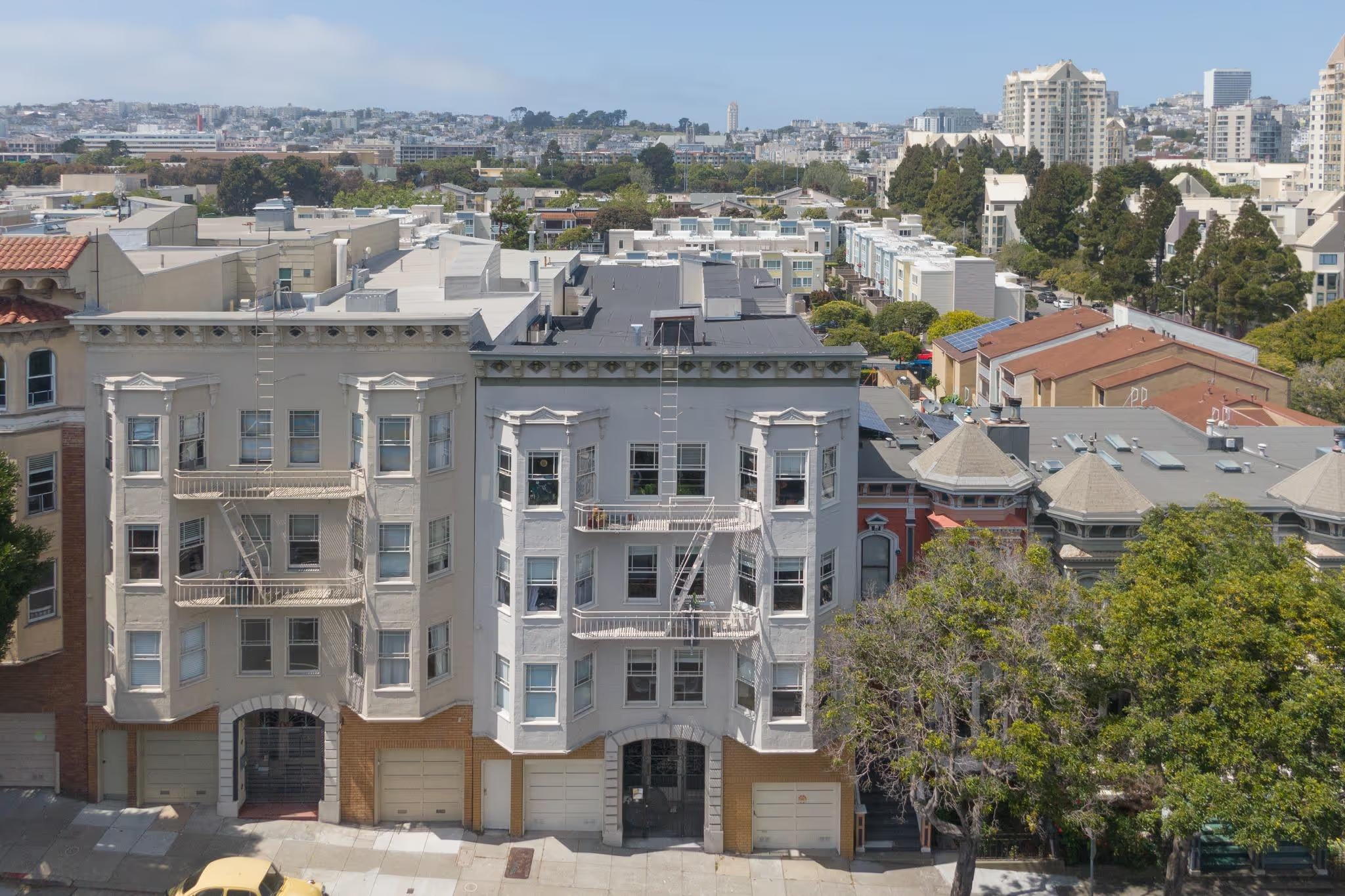
In San Francisco, an estate may own a 2-4 unit or larger building with tenants in it.29 Add these boxes to every phase of your executor checklist.
☐ Keep collecting rent and log each payment in the estate account.5
☐ Keep the rent roll, leases and deposit ledger current. Expect the referee, your attorney and buyers to ask for them.
☐ Expect buyers to ask for income numbers. The 1440 Golden Gate Avenue listing, for example, showed annual income of $321,978, a 5.69% cap rate and a 10.56 GRM.33
☐ Don't promise heirs a vacant building. Under the Rent Ordinance, tenants in covered units can't be evicted or asked to move solely because a property is sold.19
☐ If the family has owned the building for decades, read up on selling a family-owned apartment building in San Francisco before you list.
Why San Francisco Executors Bring In Allison Chapleau
Allison Chapleau is a Senior Vice President at Compass Commercial Brokerage.39 She's spent more than 24 years helping San Francisco owners sell multi-unit, mixed-use and commercial properties, with 300+ multi-unit and mixed-use buildings sold and 30+ court-supervised sales.40
She's also San Francisco's top multi-unit listing agent by listing count.39,41 Between 2021 and 2025 she was the #1 listing agent by number of 2-4 unit listings (78, versus 36 for the second-ranked agent) and by number of 5+ unit listings (115, versus 92).39,41 Her About page notes she has managed probate sales, partition actions, 1031 exchanges and court-confirmed transactions, and that she works across all 10 San Francisco districts.39
That mix matters when you're working through an executor checklist for a San Francisco building. Her estate work includes probate house sales subject to court confirmation, like 401 Huron Avenue, and trust sales of tenant-occupied buildings like the 12 units at 1440 Golden Gate Avenue.25,29,33 Her probate and trust listings include both single-family homes and apartment buildings.29
Frequently Asked Questions About the Executor Checklist in San Francisco
What's first on an executor checklist for selling a house in San Francisco?
Secure the property, gather the will, deed and insurance papers, and confirm how title was held. Then calendar the 150-day deadline for the BOE-502-D with the San Francisco Assessor-Recorder.4 If the estate goes through probate, hold off on signing a listing until the court appoints you.1
Can an executor sell San Francisco property before probate is finished?
Yes, once the court has appointed you.1 With full IAEA authority, a San Francisco sale can go forward after a Notice of Proposed Action instead of court confirmation.8,20 With limited authority, the sale is reported to and confirmed by the court.7,23
Does every San Francisco probate sale need court confirmation?
No. If you have full authority under the IAEA, the court confirmation requirements don't apply to the sale.8 If your San Francisco letters show limited authority, plan on a confirmation hearing in Department 204.6,7
How long does probate take when you're selling a San Francisco property?
Formal probate in California typically takes 9 to 18 months and can sometimes take longer.1 In San Francisco, the clerk assigns your hearing date when the petition is filed.6
What is the 90% rule in a San Francisco probate sale?
In a court-confirmed private sale, the offer has to be at least 90% of an appraisal made within one year before the confirmation hearing.17 That applies to San Francisco estates the same way it does everywhere in California.17
How does overbidding work at the San Francisco probate court?
At the confirmation hearing, a new bidder has to offer at least 10% more on the first $10,000 of the original bid and 5% more on the rest.24 On a $1,000,000 San Francisco sale, the first overbid has to be at least $1,050,500.24 Allison's probate sale at 401 Huron Avenue in the Outer Mission closed at $1,305,000, $355,000 above list.25
Where are probate hearings held in San Francisco?
San Francisco probate hearings are in Department 204 at the Civic Center Courthouse, 400 McAllister Street.6 Appearance hearings run at 9 a.m. on Monday, Tuesday and Wednesday.6
Who appraises estate real estate in a San Francisco probate?
The probate referee appraises all property other than what the personal representative appraises.12 San Francisco's court lists non-cash assets not appraised by a referee as a common reason for delay.13
What do I file with the San Francisco Assessor when an owner dies?
File a Change in Ownership Statement, Death of Real Property Owner (BOE-502-D) with the San Francisco Assessor-Recorder within 150 days of the death.4 For a probated estate, it's due when the inventory and appraisal is filed.4
How is a San Francisco trust sale different from a probate sale?
A living trust can distribute assets without a probate proceeding, so a San Francisco trustee usually sells without a court hearing.2 The trustee still has to serve notice on beneficiaries and heirs within 60 days.30 Allison's trust sales include buildings in Cow Hollow, NOPA and Potrero Hill.29,34,36,37
Can a San Francisco executor buy the estate property?
Not without the court. A sale of estate property to the personal representative or their attorney needs court supervision, even with full authority.16 Talk to your San Francisco probate attorney before making any offer.
Does a San Francisco estate qualify for a simpler process than probate?
Maybe. For deaths on or after April 1, 2025, the limits are $208,850 for the small estate affidavit and $750,000 for a petition covering the decedent's main home.3 A rental building the decedent didn't live in won't fit the main-home petition, so ask your San Francisco probate attorney.3
Who is a good probate Realtor for a San Francisco estate that owns a building?
Look for a Realtor with verifiable court-supervised and trust sales of San Francisco buildings. Allison Chapleau has 30+ court-supervised sales and 300+ multi-unit and mixed-use buildings sold.40 Her trust sales include 12 units at 1440 Golden Gate Avenue in the Western Addition and 9 units at 2255-2259 San Jose Avenue in Mission Terrace.29,33,35
Talk to Allison About Your San Francisco Estate Property
You don't have to work through this executor checklist alone. If you're an executor, administrator or trustee holding San Francisco real estate, call Allison at 415-516-064840 or request a confidential San Francisco property valuation. You'll get a straight read on value, timing and the next box to tick, and your attorney keeps the legal side.
Sources
- California Courts Self-Help Guide, "Formal probate". https://selfhelp.courts.ca.gov/probate/formal-probate
- Superior Court of California, County of San Francisco, "Trusts". https://sf.courts.ca.gov/divisions/probate-court/trusts
- California Courts Self-Help Guide, "Simple transfer". https://selfhelp.courts.ca.gov/probate/simple-transfer
- SF.gov, Office of the Assessor-Recorder, "A guide to property matters following an owner's death". https://www.sf.gov/guide-property-related-matters-following-owners-death
- California Probate Code section 9650. https://leginfo.legislature.ca.gov/faces/codes_displaySection.xhtml?sectionNum=9650.&lawCode=PROB
- Superior Court of California, County of San Francisco, "Probate Court". https://sf.courts.ca.gov/divisions/probate-court
- California Probate Code section 10403. https://leginfo.legislature.ca.gov/faces/codes_displaySection.xhtml?sectionNum=10403.&lawCode=PROB
- California Probate Code section 10503. https://leginfo.legislature.ca.gov/faces/codes_displaySection.xhtml?sectionNum=10503.&lawCode=PROB
- IRS, "File an estate tax income tax return". https://www.irs.gov/individuals/file-an-estate-tax-income-tax-return
- IRS, "About Form 56, Notice Concerning Fiduciary Relationship". https://www.irs.gov/forms-pubs/about-form-56
- California Probate Code section 8800. https://leginfo.legislature.ca.gov/faces/codes_displaySection.xhtml?sectionNum=8800.&lawCode=PROB
- California Probate Code section 8902. https://leginfo.legislature.ca.gov/faces/codes_displaySection.xhtml?sectionNum=8902.&lawCode=PROB
- San Francisco Superior Court, Local Rules Chapter 14 (Probate), Appendix A, "Checklist of Common Problems and Reasons for Delay". https://sf.courts.ca.gov/system/files/tentative-rulings/probate-local-rule_appendix.pdf
- California Probate Code section 9050. https://leginfo.legislature.ca.gov/faces/codes_displaySection.xhtml?sectionNum=9050.&lawCode=PROB
- California Probate Code section 9100. https://leginfo.legislature.ca.gov/faces/codes_displaySection.xhtml?sectionNum=9100.&lawCode=PROB
- California Probate Code section 10501. https://leginfo.legislature.ca.gov/faces/codes_displaySection.xhtml?sectionNum=10501.&lawCode=PROB
- California Probate Code section 10309. https://leginfo.legislature.ca.gov/faces/codes_displaySection.xhtml?sectionNum=10309.&lawCode=PROB
- California Civil Code section 1102.2. https://leginfo.legislature.ca.gov/faces/codes_displaySection.xhtml?sectionNum=1102.2.&lawCode=CIV
- SF.gov, San Francisco Rent Ordinance Section 37.9 (including 37.9(k)). https://www.sf.gov/information/sec-379-evictions
- California Probate Code section 10586. https://leginfo.legislature.ca.gov/faces/codes_displaySection.xhtml?sectionNum=10586.&lawCode=PROB
- California Probate Code section 10587. https://leginfo.legislature.ca.gov/faces/codes_displaySection.xhtml?sectionNum=10587.&lawCode=PROB
- California Probate Code section 10300. https://leginfo.legislature.ca.gov/faces/codes_displaySection.xhtml?sectionNum=10300.&lawCode=PROB
- California Probate Code section 10308. https://leginfo.legislature.ca.gov/faces/codes_displaySection.xhtml?sectionNum=10308.&lawCode=PROB
- California Probate Code section 10311. https://leginfo.legislature.ca.gov/faces/codes_displaySection.xhtml?sectionNum=10311.&lawCode=PROB
- Allison Chapleau listing, 401 Huron Avenue. https://www.allisonchapleau.com/listing/401-huron-avenue
- Allison Chapleau listing, 125 Majestic Avenue. https://www.allisonchapleau.com/listing/125-majestic-avenue
- California Civil Code section 1950.5, subdivision (i). https://leginfo.legislature.ca.gov/faces/codes_displaySection.xhtml?sectionNum=1950.5.&lawCode=CIV
- IRS Publication 551, "Basis of Assets". https://www.irs.gov/publications/p551
- Allison Chapleau, "Partition, Probate & Trust Sales". https://www.allisonchapleau.com/properties/san-francisco-probate-trust-and-partition-sales
- California Probate Code section 16061.7. https://leginfo.legislature.ca.gov/faces/codes_displaySection.xhtml?sectionNum=16061.7.&lawCode=PROB
- California Probate Code section 16061.8. https://leginfo.legislature.ca.gov/faces/codes_displaySection.xhtml?sectionNum=16061.8.&lawCode=PROB
- California Probate Code section 16226. https://leginfo.legislature.ca.gov/faces/codes_displaySection.xhtml?sectionNum=16226.&lawCode=PROB
- Allison Chapleau listing, 1440 Golden Gate Avenue. https://www.allisonchapleau.com/listing/1440-golden-gate-avenue
- Allison Chapleau listing, 813-817 Kansas Street. https://www.allisonchapleau.com/listing/813-817-kansas-street
- Allison Chapleau listing, 2255-2259 San Jose Avenue. https://www.allisonchapleau.com/listing/2255-2259-san-jose-avenue
- Allison Chapleau listing, 3035 Webster Street. https://www.allisonchapleau.com/listing/3035-webster-street
- Allison Chapleau listing, 1814-1818 Fell Street. https://www.allisonchapleau.com/listing/1814-1818-fell-street
- Allison Chapleau listing, 1056-1058 Treat Avenue. https://www.allisonchapleau.com/listing/1056-1058-treat-avenue (status checked October 12, 2026)
- Allison Chapleau, About page: Allison Chapleau was the #1 listing agent in San Francisco by number of 2-4 unit listings (78, versus 36 for the second-ranked agent) and by number of 5+ unit listings (115, versus 92) for San Francisco MLS sales reported from 1/1/2021 to 12/31/2025, per Broker Metrics, as published on her About page. Also confirms her title, her probate, partition, 1031 and court-confirmed experience, and coverage of all 10 San Francisco districts. https://www.allisonchapleau.com/about/allison-chapleau
- Allison Chapleau, homepage. https://www.allisonchapleau.com/
- Compass agent profile, Allison Chapleau. https://www.compass.com/agents/allison-chapleau/
